Cuvier’s beaked whale (Ziphius cavirostris) is a member of a rarely seen, little known and little studied group of whales – the beaked whales – that are in fact widespread, relatively common and completely remarkable. The particular claim to fame of Cuvier’s beaked whale is its astonishing diving capabilities: it holds the record for the deepest dive by an air-breathing animal (without the aid of a submarine!). So we’re heading out, into the open ocean, to visit with one of the most rarely seen large animals on Earth, and to follow it away from the air and the light into the midnight zone …
Subscribe to the Podcast and never miss a Wild Episode! (P.S. Make your friends and family subscribe too!)
And please do E-mail the show if you have any comments, complaints, corrections, suggestions, encouragement or even just want to say hello.
And don’t forget, you can now check out The Wild Episode’s very own Facebook page.
Read on for links to more info, and most importantly video of the elusive Cuvier’s beaked whale, in the shownotes …
Let’s cut right to the chase. Cuvier’s beaked whale is hard to find and hard to see, but people have found and seen it …
First, beautiful drone footage of a mother and calf pair (which, incidentally, describes them as ‘rare’ – I’d say that’s an unconvincing claim; they’re incredibly rarely seen, but that’s a whole different thing):
Second, and my favourite, to be honest, a chance encounter for a very lucky bunch of tourists. The best thing about this, I think, is the voices of the whale-watchers, at least some of whom clearly appreciate just what a rare privilege seeing what they’re seeing is: towards the end, you can hear a guy say something to the effect of ‘I thought it might be Cuvier’s, but I thought that’s just too crazy’. Not crazy at all, as it turned out:
And here’s a rather nicely mounted skeleton, showing the framework of this lean, mean diving machine:
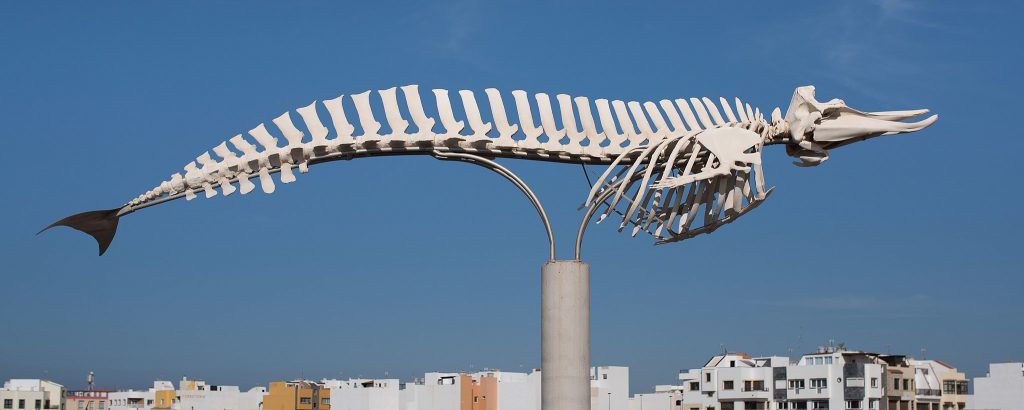
Photo credit : Bengt Nyman [CC BY 3.0]
There are quite a few openly available research and information papers detailing the recent revelations about Ziphius cavisrostris, so here are a few to get you started:
The National Oceanic and Atmospheric Administration has a species review for Z. cavirostris, with plenty of basic info (but note this link takes you straight to the PDF!): Species review of Cuvier’s beaked whale, Ziphius cavirostris
The most recent substantive review I found of available info on the whale’s diet: Santos, M & Pierce, Graham & Herman, Jeremy & Loez, A & Guerra, Angel & Mente, Eleni & Clarke, M.R.. (2001). Feeding ecology of Cuvier’s beaked whale (Ziphius cavirostris): A review with new information on the diet of this species. Journal of the Marine Biological Association of the UK. 81.
Extensive, open access study on the diving behaviour of Cuvier’s off the east coast of the USA : Shearer Jeanne M., Quick Nicola J., Cioffi William R., Baird Robin W., Webster Daniel L., Foley Heather J., Swaim Zachary T., Waples Danielle M., Bell Joel T. and Read Andrew J. Diving behaviour of Cuvier’s beaked whales (Ziphius cavirostris) off Cape Hatteras, North Carolina 6R. Soc. open sci.
And the specific study, of whales off California, that recorded the record-breaking dive : Schorr GS, Falcone EA, Moretti DJ, Andrews RD (2014) First Long-Term Behavioral Records from Cuvier’s Beaked Whales (Ziphius cavirostris) Reveal Record-Breaking Dives. PLoS ONE 9(3): e92633.
BUT! I may have to revisit this subject in a future update episode, because (a), I think I might have mistakenly conflated the deepest ever dive and the longest dive – not sure they’re actually the same dive (kind of minor point, but still constitutes a possible mistake!).
More significantly, I touched on but kind of glossed over the significant questions and concerns surrounding the interaction between Cuvier’s beaked whale and human-generated sound, especially military sonar. This is a complex and worrying area of research. The effects of human sonar on Z. cavisrostris behaviour (including how deep they dive, how rapidly they ascend and so on) are incompletely understood, but well worth thinking about. See, for example, a formal response to that last article above, questioning the normality of the whale’s behaviour : Tyack PL, Calambokidis J, Friedlaender A, Goldbogen J, Southall B (2015) Formal Comment on Schorr GS, Falcone EA, Moretti DJ, Andrews RD (2014) First Long-Term Behavioral Records from Cuvier’s Beaked Whales (Ziphius cavirostris) Reveal Record-Breaking Dives. PLoS ONE 9(3): e92633. doi:10.1371/journal.pone.0092633. PLoS ONE 10(12): e0142287
and, a response to that response by the original authors, which acknowledges many of the uncertainties: Schorr GS, Falcone EA, Moretti DJ, Andrews RD (2015) Rebuttal to the Formal Comment on Schorr et al. (2014) submitted by Tyack et al. (2015). PLoS ONE 10(12): e0142437
This is how science works (or should!) Dialogue, back and forth. Good stuff.
Music
Opening & Closing Themes: Running Waters and Acoustic Meditation by Audionautix (Jason Shaw), from audionautix.com. CC BY 3.0.
Modified versions of the following pieces:
I Should Have Been More Human, Stories About the World That Once Was and We Were Never Meant to Live Here by Chris Zabriskie. CC BY 4.0