The bat-eared fox (Otocyon megalotis) may not look out of the ordinary (apart from its big ears) but it is. Known as the only insectivorous dog in the world, it has the most teeth and the probably the fastest jaw of any wild dog. It also has a very unusual way of going about the business of raising the next generation …
Subscribe to the Podcast and never miss a Wild Episode! (P.S. Make your friends and family subscribe too!)
And please do E-mail the show if you have any comments, complaints, corrections, suggestions, encouragement or even just want to say hello.
And don’t forget, you can now check out The Wild Episode’s very own Facebook page. And, you can find and follow the show on Twitter!
Show notes below …
The bat-eared fox is a fine-looking dog …

Photo credit: By Derek Keats from Johannesburg, South Africa – Bat-eared fox, Kgalagadi Transfrontier Park, CC BY 2.0.
… often to be seen, in its preferred short-grass habitat, in numbers larger than one …

Photo credit: By Derek Keats from Johannesburg, South Africa – Bat-eared fox, Otocyon megalotis, at Kgalagadi Transfrontier Park, Northern Cape, South Africa, CC BY 2.0.
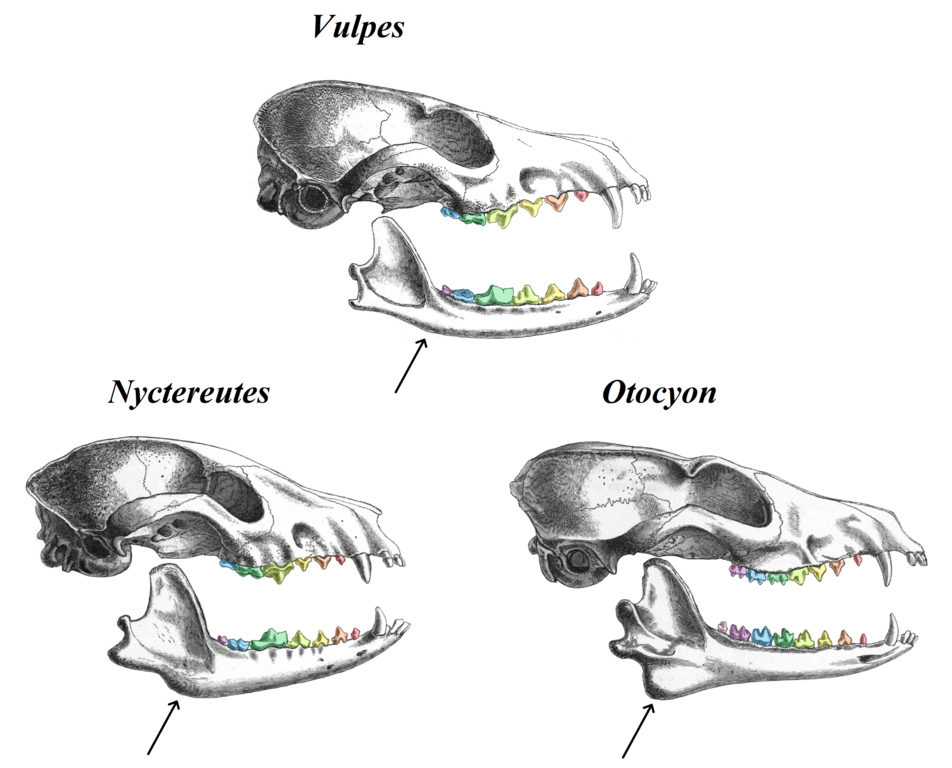
… and here’s a diagram showing that they’ve got other, related dogs beaten when it comes to teeth (the bat-eared fox is at bottom right in the image). The bat-eared fox’s extra teeth are at the back of the jaw, but you can also see here – thanks to the helpful arrows – that their jaw is a noticeably different shape, too, allowing them to use a distinctive muscle/jaw combo to chew extremely fast:
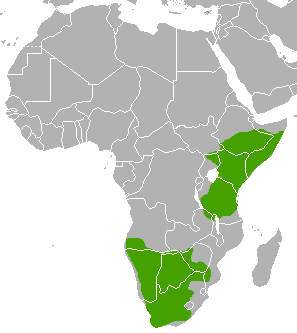
Here’s a distribution map, showing the two separate populations in southern and eastern Africa:
San Diego Zoo has some bat-eared foxes in its collection, and as a result has a handy webpage giving a non-technical overview of Otocyon megoaltis.
There’s no shortage of slightly more technical stuff to read about them, too, so here are just a few links to get you started if you want to know more …
On diet:
Direct PDF link! Stuart, Chris & Stuart, T. & Pereboom, Vincent. (2003). Diet of the bat-eared fox (Otocyon megalotis), based on scat analysis, on the Western Escarpment, South Africa. Canid News. 6.
MPS Berry, 1981, Stomach contents of bar-eared foxes, Otocyon megalotis, from the northern Transvaal, South African Journal of Wildlife Research 11(1).
J.AJ, Nel. (1990). Foraging and feeding by bat-eared foxes Otocyon megalotis in the southwestern Kalahari. Koedoe : African Protected Area Conservation and Science. 33.
On teeth:
Koyasu, Kazuhiro. (1993). Variability of dentition in the bat-eared fox, Otocyon megalotis. Aichi-Gakuin Journal of Dental Science. 31. 63-104.
On their social lives:
Harry W. Y. Wright, Melissa M. Gray, Robert K. Wayne, Rosie B. Woodroffe, 2010, Mating tactics and paternity in a socially monogamous canid, the bat-eared fox (Otocyon megalotis), Journal of Mammalogy, Volume 91, Issue 2.
Direct PDF link! Pauw, A., 2000. “Parental care in a polygynous group of bat-eared foxes, Otocyon megalotis (Carnivora: Canidae).” African Zoology 35: 139 – 145.
Unfortunately, two of the key articles I used in this episode aren’t quite so easily accessible online, I don’t think – but I’m going to refer to them here anyway, since you can always read the abstract if you want to:
Wright, Harry. (2006). Paternal den attendance is the best predictor of offspring survival in the socially monogamous bat-eared fox. Animal Behaviour. 71. 503-510.
Klare, Unn & Kamler, Jan & Macdonald, David. (2011). The bat-eared fox: A dietary specialist?. Mammalian Biology – MAMM BIOL. 76. 646-650.
Music
Opening & Closing Themes: Running Waters and Acoustic Meditation by Audionautix (Jason Shaw), from audionautix.com. CC BY 3.0.
Modified versions of the following pieces:
Rotisserie Graveyard, It Looks Like the Future but it Feels Like the Past, Kiss Inflation and The Ants Built a City on his Chest by Doctor Turtle. CC BY 4.0