The European Beewolf (Philanthus triangulum) is a big, striking wasp. A specialist predator of honeybees, with many tricks up its sleeve: chemical and biological warfare tricks, including symbiotic bacteria, embalming and poison gas.
Subscribe to the Podcast and never miss a Wild Episode! (P.S. Make your friends and family subscribe too!)
And please do E-mail the show if you have any comments, complaints, corrections, suggestions, encouragement or even just want to say hello.
And don’t forget, you can now check out The Wild Episode’s very own Facebook page. And, you can find and follow the show on Twitter!
Show notes, with some particularly nice photos and videos this time, below …
A European Beewolf taking a paralyzed bee into her tunnel:

Photo credit : Charlie Jackson, CC BY 2.0 via flickr
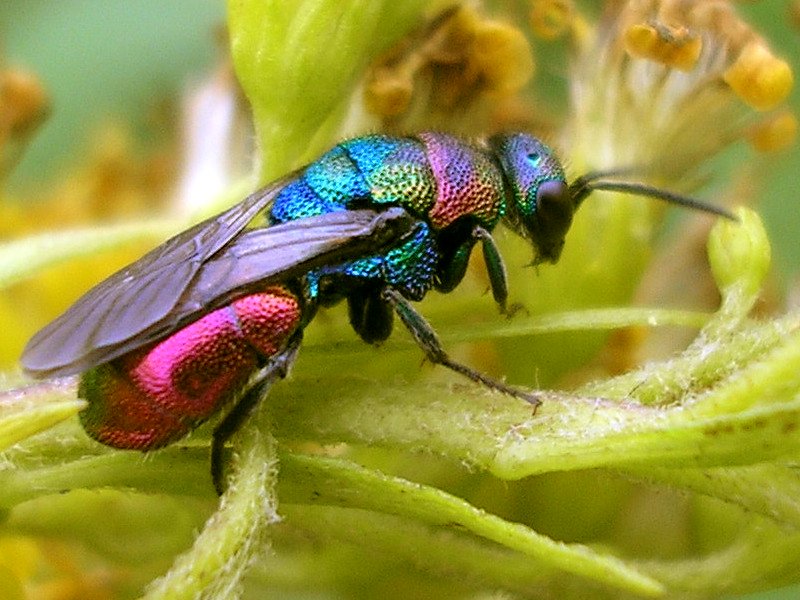
The exquisite Hedychrum rutilans, the cuckoo wasp that targets the Beewolf:
Beewolf vs Honeybee:
… and Beewolf vs Hedychrum rutilans:
As I mentioned in the episode, most of the research on the European Beewolf is by German scientists, and one in particular, Prof. Dr. Erhard Strohm. You can see a brief overview of his research and a (not 100% complete, I don’t think, but nearly) list of all the published papers on the Beewolf he’s been involved in (which accounts for much of what we know about this species), over here.
That preceding link is actually a far, far better guide to available beewolf-related research than anything I could mention – and there’s a whole lot of fascinating stuff in there that I never even got to in the episode – but anyway here’s just a handful of papers of particular relevance to the stuff I do talk about in the episode:
Martin Kaltenpoth, Wolfgang Göttler, Gudrun Herzner, Erhard Strohm, Symbiotic Bacteria Protect Wasp Larvae from Fungal Infestation, Current Biology, Volume 15, Issue 5, 2005, Pages 475-479.
Herzner, Gudrun & Strohm, Erhard. (2008). Food wrapping by females of the European Beewolf, Philanthus triangulum, retards water loss of larval provisions. Physiological Entomology. 33. 101 – 109.
Herzner, Gudrun & Strohm, Erhard. (2007). Fighting fungi with physics: Food wrapping by a solitary wasp prevents water condensation. Current biology : CB. 17. R46-7.
Strohm, Erhard & Herzner, Gudrun & Ruther, Joachim & Kaltenpoth, Martin & Engl, Tobias. (2019). Nitric oxide radicals are emitted by wasp eggs to kill mold fungi. eLife Sciences. 8. e43718.
Strohm, Erhard & Kroiss, Johannes & Herzner, Gudrun & Laurien-Kehnen, Claudia & Boland, Wilhelm & Schreier, Peter & Schmitt, Thomas. (2008). A cuckoo in wolves’ clothing? Chemical mimicry in a specialized cuckoo wasp of the European beewolf (Hymenoptera, Chrysididae and Crabronidae). Frontiers in zoology. 5. 2.
Music
Opening & Closing Themes: Running Waters and Acoustic Meditation by Audionautix (Jason Shaw), from audionautix.com. CC BY 3.0.
Modified versions of:
Danse Macabre – No Violin, Vanishing and When The Wind Blows by Kevin MacLeod (incompetech.com), CC BY 3.0.