
First in a series of listener-suggested shows! The Wasp Mantidfly (Climaciella brunnea) is a stunning little insect with some amazing stuff going on. Mimicry, convergent evolution, phoresy, egg predation, hypermetamorphosis, insects striking back against insect-eating spiders and much, much more. This episode’s got it all …
Subscribe to the Podcast and never miss a Wild Episode! (P.S. Make your friends and family subscribe too!)
And please do E-mail the show if you have any comments, complaints, corrections, suggestions, encouragement or even just want to say hello.
And don’t forget, you can now check out The Wild Episode’s very own Facebook page. And, you can find and follow the show on Twitter!
Show notes available below …
Polymorphism ahoy! Here’s a Climaciella brunnea from Florida, USA:

Photo credit: By Katja Schulz from Washington, D. C., USA, via Wikimedia Commons – Wasp Mantidfly, CC BY 2.0
and here’s one in California, USA:

Photo credit: Ken-ichi Ueda, via iNaturalist, CC BY 4.0
Music
… and here’s one in southern Mexico:
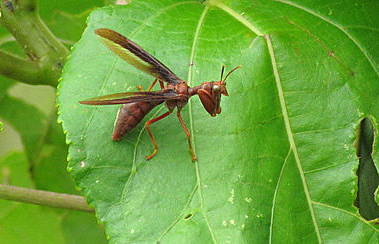
Photo credit: Martín Sánchez Vilchis, via iNaturalist, CC BY-SA 4.0
I could go on, but that’s probably enough to make the polymorphic point, right?
Here’s some great footage of one moving around in foliage:
There are, as I said in the episode, not that many easily accessible scientific papers on the wasp mantidfly (not super-recnet ones, anyway), but there’s a whole lot of good information available online in slightly more informal formats. Such as:
Bug Guide: Species Climaciella brunnea – Brown Wasp Mantidfly (loads of great photos of different color morphs from around the US in this – amazing stuff).
LSU College of Agriculture: Climaciella brunnea, The Wasp Mantidfly (Mantispidae: Neuroptera)
University of Wisconsin: Wasp Mantidfly
Bug Eric: Wasp Mantisfly
But there are some pretty amazing scientific papers available, either about Climaciella brunnea itself, or related topics:
(But first, just because I mentioned it, here’s the paper on polymorphic Batesian mimicry in a sea snake, which hints at some of the complexities surrounding this topic: Shine, R., Brown, G.P. & Goiran, C. Frequency-dependent Batesian mimicry maintains colour polymorphism in a sea snake population. Sci Rep 12, 4680 (2022).)
Snyman, L. P., Ohl, M., Pirk, C. W. W., & Sole, C. L. (2020). A review of the biology and biogeography of Mantispidae (Neuroptera), Insect Systematics & Evolution, 52(2), 125-166.
Redborg, Kurt. (2009). Resource partitioning of spider hosts (Arachnida, Araneae) by two mantispid species (Neuroptera, Mantispidae) in an Illinois woodland. Journal of Arachnology. 28. 70-78.
Boyden, 1983, Mimicry, Predation and Potential Pollination by the Mantispid, Climaciella brunnea var. instabilis (Say) (Mantispidae: Neuroptera), Journal of the New York Entomological Society, 508-511
Direct Link to PDF via the Lacewing Digital Library! Kurt E. Redborg & Ellis G. Macleod (1983) Climaciella brunnea (Neuroptera: Mantispidae): a mantispid that obligately boards spiders, Journal of Natural History, 17:1, 63-73
Direct Link to PDF via the Lacewing Digital Library! Scheffer, S.J. Transfer of a larval Mantispid during copulation of its spider host. J Insect Behav 5, 797–800 (1992).
Direct Link to PDF via the Lacewing Digital Library! Opler, P. A. (1981). Polymorphic Mimicry of Polistine Wasps by a Neotropical Neuropteran. Biotropica, 13(3), 165–176.
Music
Opening & Closing Themes: Running Waters and Acoustic Meditation by Audionautix (Jason Shaw), CC BY 3.0.