
The Tri-spine Horseshoe Crab (Tachypleus tridentatus) is one of four living horseshoe crab species (probably, marginally, the biggest). Animals that have survived, superficially very little changed, for hundreds of millions of years. They’ve come through multiple mass extinctions, but are still facing new and unexpected challenges today …
Subscribe to the Podcast and never miss a Wild Episode! (P.S. Make your friends and family subscribe too!)
And please do E-mail the show if you have any comments, complaints, corrections, suggestions, encouragement or even just want to say hello.
And don’t forget, you can now check out The Wild Episode’s very own Facebook page. And, you can find and follow the show on Twitter!
Show notes available below …
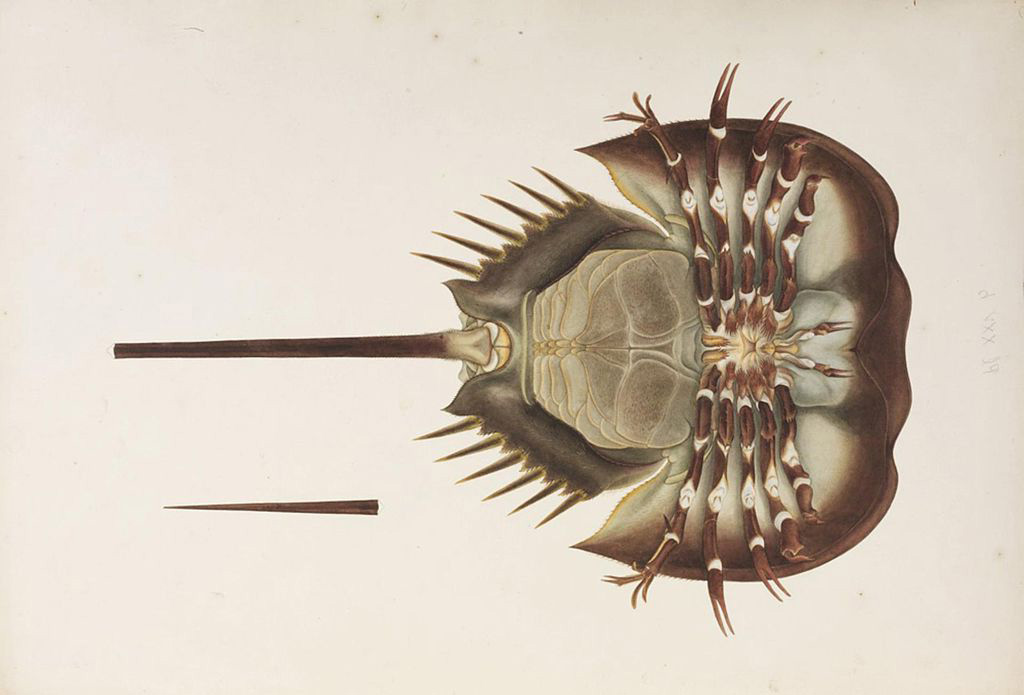
Nice old drawings of the Tri-Spine Horseshoe Crab, seen from above …

… and below:
And a little video of one in its natural habitat, doing its quiet, ancient, scuttling thing:
The IUCN Red List page on the Tri-spine Horseshoe Crab has a lot of information, especially if you click on the ‘Population’ and ‘Use and Trade’ tabs. (You can actually access the PDF of the full 2019 assessment for the species – a very extensive (and long!) mine of useful information).
The Ecological Research & Development Group – despite the general name, a group specifically advocating for horseshoe crab conservation – has a handy website giving an overview of all four species and the threats to them.
For an introduction to the problems surrounding Endotoxin Detection Testing and the threat it poses to horseshoe crabs: Horseshoe Crabs Are at Risk — So Endotoxin Tests Are, Too.
And a selection of the science:
Wada, Toshifumi & Mitsushio, Takahiro & Inoue, Shinya & Koike, Hiroko & Kawabe, Ryo. (2016). Movement Patterns and Residency of the Critically Endangered Horseshoe Crab Tachypleus tridentatus in a Semi-Enclosed Bay Determined Using Acoustic Telemetry. PLoS ONE. 11.
Kwan, B.K.Y., Shin, P.K.S., Cheung, S.G. (2015). Preliminary Home Range Study of Juvenile Chinese Horseshoe Crabs, Tachypleus tridentatus (Xiphosura), Using Passive Tracking Methods. In: Carmichael, R., Botton, M., Shin, P., Cheung, S. (eds) Changing Global Perspectives on Horseshoe Crab Biology, Conservation and Management. Springer, Cham.
Lee Bo Yee, Wakabayashi Kaori, Sin Simon Yung Wa, Ohtsuka Susumu, Tsang Ling Ming, 2021, DNA Metabarcoding Revealed Interspecific Dietary Difference and Prey Selectivity in Juvenile Horseshoe Crabs Carcinoscorpius rotundicauda and Tachypleus tridentatus From Hong Kong, Frontiers in Marine Science, 8.
(This one’s basically a book): Tanacredi, John & Botton, Mark & Smith, David. (2009). Biology and Conservation of Horseshoe Crabs.
Mark L. Botton, Carl N. Shuster Jr., Koichi Sekiguchi, Hiroaki Sugita “Amplexus and Mating Behavior in the Japanese Horseshoe Crab, Tachypleus tridentatus,” Zoological Science, 13(1), 151-159, (1 February 1996)
Yongyan Liao, Ke Liu, Haiping Wu, Youhou Xu, Hu Huang, Shuqing Xu & Kit Yue Kwan (2019) How survival and food intake of tri-spine horseshoe crabs, Tachypleus tridentatus respond to thermal variation: implications for understanding its distribution limit, Journal of Natural History, 53:31-32
Hu, Menghong & Wang, Youji & Chen, Yan & Cheung, Siu Gin & Shin, Paul & Li, Qiang. (2009). Summer distribution and abundance of juvenile Chinese horseshoe crabs Tachypleus tridentatus along an intertidal zone in southern China. Aquatic Biology – AQUAT BIOL. 7. 107-112.
Vestbo, Stine & Obst, Matthias & Fernandez, Francisco & Intanai, Itsara & Funch, Peter. (2018). Present and Potential Future Distributions of Asian Horseshoe Crabs Determine Areas for Conservation. Frontiers in Marine Science. 5. 164.
Music
Opening & Closing Themes: Running Waters and Acoustic Meditation by Audionautix (Jason Shaw), from audionautix.com. CC BY 3.0.
Modified versions of: Modum by Kai Engel, CC BY 3.0, Another Version of You and An Extraordinary Camera Was Custom Built and Used Only Once by Chris Zabriskie, CC BY 3.0