The Vampire Squid (Vampyroteuthis infernalis) is not really a vampire, nor is it really a squid. It’s the last survivor of an ancient lineage that has arrived in the present with an astonishing array of adaptations that equip it to live in a place most other animals can only visit … the oxygen minimum zone.
Subscribe to the Podcast and never miss a Wild Episode! (P.S. Make your friends and family subscribe too!)
If you want to support the podcast, and help keep it going, please share it on social media, and rate and review it (possitively of course!) on your podcast app.
And please do E-mail the show if you have any comments, complaints, corrections, suggestions, encouragement or even just want to say hello.
And don’t forget, you can now check out The Wild Episode’s very own Facebook page. And, you can find and follow the show on Twitter!
Show notes below …
Lovely footage of a Vampire Squid just hanging out:
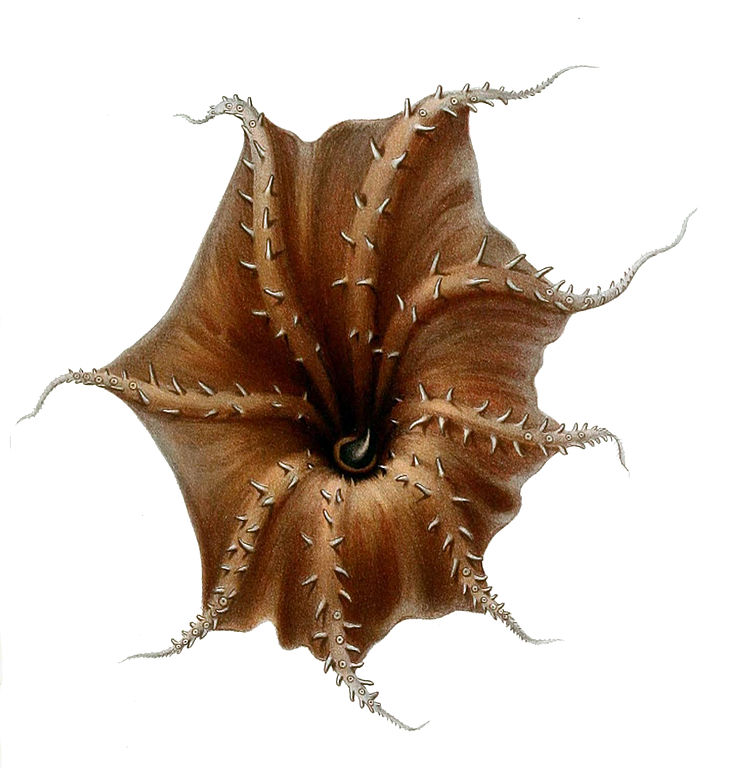
An early illustration of Vampyroteuthis infernalis:

A front-end view of the Vampire Squid’s arms, nicely showing webbing and soft spikes:
A more up to date illustration, showing both photophores and one of the thread-like retractile filaments:
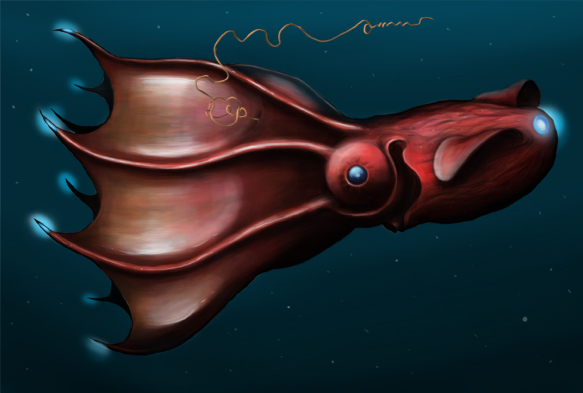
Photo credit: © Citron, via wikimedia commons, CC BY-SA 3.0
And a photo of a juvenile Vampire Squid:

And finally, a kind of awesome GIF that shows one of the retractile filaments fully extended (thanks to Rogue Time Lord One for posting this on twitter in response to the Wild Episode twitter post for this episode!):
An intro to the Vampire Squid at The Cephalod Page.
And another, complete with great photos and video, at the Monterey Bay Aquarium page.
Science:
A great, very accessible, introduction and review of then-current research: Steckler, D. (2015). Breathing easy in an oligoxic world: Vampyroteuthis infernalis (Phy. Mollusca, Cl. Cephalopoda) adaptations to the oxygen minimum zone. MacEwan University Student EJournal, 2(1).
Seibel, Brad & Chausson, Fabienne & Lallier, François & Zal, Franck & Childress, James. (1999). Vampire blood: Respiratory physiology of the vampire squid (Cephalopoda: Vampyromorpha) in relation to the oxygen minimum layer. Experimental Biology Online. 4. 1-10.
Seibel, Brad & Thuesen, Erik & Childress, James & Francis, Laura. (1997). Decline in Pelagic Cephalopod Metabolism With Habitat Depth Reflects Differences in Locomotory Efficiency. Biological Bulletin. 192. 262-278.
BA Seibel, EV Thuesen, JJ Childress; Flight of the vampire: ontogenetic gait-transition in Vampyroteuthis infernalis (Cephalopoda: vampyromorpha). J Exp Biol 15 August 1998; 201 (16): 2413–2424.
Breitburg, Denise & Levin, Lisa & Oschlies, Andreas & Grégoire, Marilaure & Chavez, Francisco & Conley, Daniel & Garcon, V. & Gilbert, Denis & Gutiérrez, Dimitri & Isensee, Kirsten & Jacinto, Gil & Limburg, Karin & Montes, Ivonne & Naqvi, S.W.A. & Pitcher, Grant & Rabalais, N. & Rose, Kenneth & Seibel, Brad & Zhang, Jing. (2018). Declining oxygen in the global ocean and coastal waters. Science (New York, N.Y.). 359.
Golikov, A.V., Ceia, F.R., Sabirov, R.M. et al. The first global deep-sea stable isotope assessment reveals the unique trophic ecology of Vampire Squid Vampyroteuthis infernalis (Cephalopoda). Sci Rep 9, 19099 (2019).
Hoving, H. & Robison, Bruce. (2012). Vampire squid: Detritivores in the oxygen minimum zone. Proceedings. Biological sciences / The Royal Society. 279. 4559-67.
Henk-Jan T. Hoving, Vladimir V. Laptikhovsky, Bruce H. Robison, Vampire squid reproductive strategy is unique among coleoid cephalopods, Current Biology, Volume 25, Issue 8, 2015, Pages R322-R323.
Robison, Bruce H et al. “Light Production by the Arm Tips of the Deep-Sea Cephalopod Vampyroteuthis infernalis.” The Biological Bulletin 205 (2003): 102 – 109.
Music
Opening & Closing Themes: Running Waters and Acoustic Meditation by Audionautix (Jason Shaw), from audionautix.com. CC BY 3.0.
The Long Journey, Gone, It’s A Mystery and How I Used To See The Stars by Lee Rosevere, CC BY 3.0