
The São Tomé Caecilian (Schistometopum thomense) is a fantastic creature: an extremely yellow legless amphibian living in the soil on a single volcanic island. An extraordinary example of an already extraordinary group of animals.
Subscribe to the Podcast and never miss a Wild Episode! (P.S. Make your friends and family subscribe too!)
If you want to support the podcast, and help keep it going, please share it on social media, and rate and review it (positively of course!) on your podcast app.
And please do E-mail the show if you have any comments, complaints, corrections, suggestions, encouragement or even just want to say hello.
And don’t forget, you can now check out The Wild Episode’s very own Facebook page. And, you can find and follow the show on Twitter!
Show notes below …
The magnificent São Tomé Caecilian:
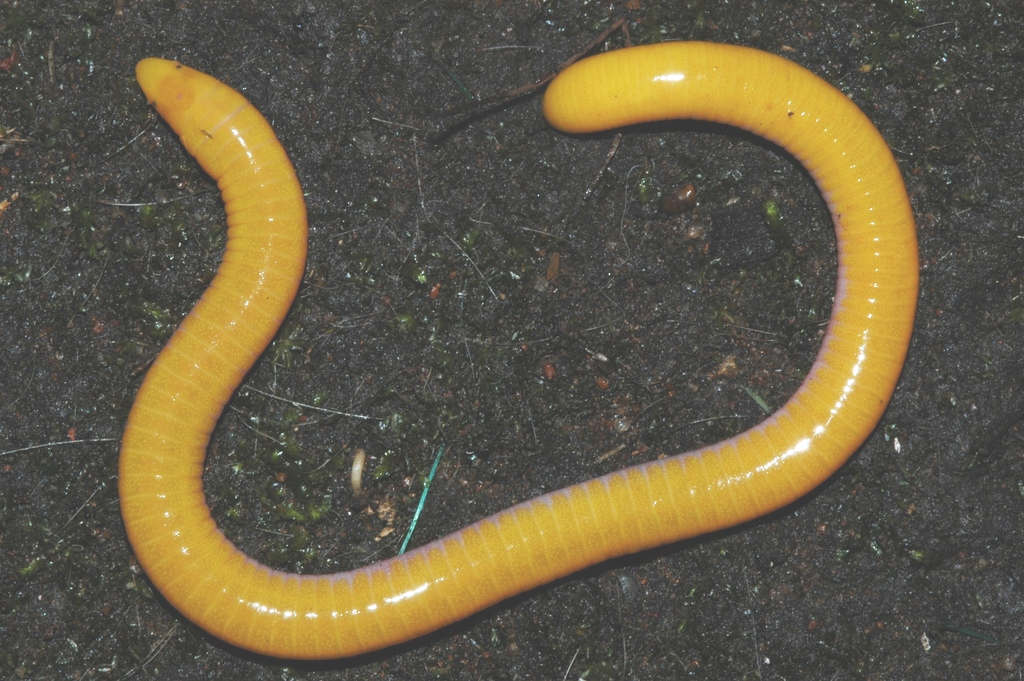
But to really get a feel for how easily, and almost inevitably, someone might mistake this creature for a worm or a snake, I think you kind of have to see it in motion, in life. I think it’s perfectly reasonable to have trouble believing that this is an amphibian:
For an intro to the remarkable reproductive – especially from the maternal point of view – habits of caecilians in general: Croaking Science: Caecilians – unusual reproductive ecology
For a concise intro to the situation re: genetics, speciation and so on on São Tomé in particular (fuller details are in papers linked below): The Unique Caecilians of São Tomé Island.
And for about the most complete overview of general natural history knowledge about the São Tomé Caecilian: AmphibiaWeb – Schistometopum thomense.
Science
Direct PDF link! Herrel A, Measey GJ. Feeding underground: kinematics of feeding in caecilians. J Exp Zool A Ecol Genet Physiol. 2012 Nov;317(9):533-9.
Measey, John & Herrel, Anthony. (2007). Rotational feeding in caecilians: Putting a spin on the evolution of cranial design. Biology letters. 2. 485-7.
Measey, John & Van Dongen, Stefan. (2006). Bergmann’s rule and the terrestrial caecilian Schistometopum thomense (Amphibia: Gymnophiona: Caeciliidae). Evolutionary ecology research. 8. 1049-1059.
Delêtre, Marc & Measey, John. (2004). Sexual selection vs. ecological causation in a sexually dimorphic caecilian, Schistometopum thomense (Amphibia: Gymnophiona: Caeciliidae). Ethology Ecology and Evolution. 16. 243-253.
Nussbaum, Ronald & Pfrender, Michael. (1998). Revision of the African caecilian genus Schistometopum Parker (Amphibia: Gymnophiona: Caeciliidae). Miscellaneous Publications Museum of Zoology University of Michigan. 187.
Stoelting RE, Measey GJ, Drewes RC (2014) Population Genetics of the São Tomé Caecilian (Gymnophiona: Dermophiidae: Schistometopum thomense) Reveals Strong Geographic Structuring. PLoS ONE 9(8): e104628
Direct PDF link! O’Connell, Kyle & Prates, Ivan & Scheinberg, Lauren & Mulder, Kevin & Bell, Rayna. (2021). Speciation and secondary contact in a fossorial island endemic, the São Tomé caecilian. Molecular Ecology. 30.
And for those with access to JSTOR, since as far as I can tell that’s the only easily (and legally) available source for these (you can get a completely free JSTOR account here, with nothing more than an e-mail address):
P. K. Ducey, et al. “Experimental Examination of Burrowing Behavior in Caecilians (Amphibia: Gymnophiona): Effects of Soil Compaction on Burrowing Ability of Four Species.” Herpetologica, vol. 49, no. 4, 1993, pp. 450–57.
Elizabeth E. Teodecki, et al. “Head Dimorphism and Burrowing Speed in the African Caecilian Schistometopum Thomense (Amphibia: Gymnophiona).” Herpetologica, vol. 54, no. 2, 1998, pp. 154–60
Music
Opening & Closing Themes: Running Waters and Acoustic Meditation by Audionautix (Jason Shaw), from audionautix.com. CC BY 3.0.
Modified versions of: Minor With Cricket and Second Nature by Audionautix (Jason Shaw), from audionautix.com. CC BY 3.0 and Dizzy Spells – Instrumental by Josh Woodward. CC BY 4.0.