The leopard (Panthera pardus) is the most flexible, adaptable big cat in the world, with a surprisingly long history of visiting urban areas. Sharing your city with a large predator brings problems, but maybe there’s an upside, because of how, and what, urban leopards are hunting …
Subscribe to the Podcast and never miss a Wild Episode! (P.S. Make your friends and family subscribe too!)
If you want to support the podcast, and help keep it going, please share it on social media, and rate and review it (positively of course!) on your podcast app.
And please do E-mail the show if you have any comments, complaints, corrections, suggestions, encouragement or even just want to say hello.
And don’t forget, you can now check out The Wild Episode’s very own Facebook page. And, you can find and follow the show on Twitter!
Click ‘view post’ for the show notes …
For an overview of human-leopard interactions in India, a good interview here with the leading expert on the subject, Dr. Vidya Athreya:
And a very nice short film specifically about research on the Mumbai leopards:
The Official Website of Sanjay Gandhi National Park.
Leopards in Seoul in the 19th century:
George William Gilmore’s Korea, From Its Capital, 1892.
Arnold Henry Savage Landor’s Corea or Cho-sen: The Land of the Morning Calm, 1894.
Powell, Joshua & Axmacher, Jan & Linnell, John & Durant, Sarah. (2021). Diverse Locations and a Long History: Historical Context for Urban Leopards (Panthera pardus) in the Early Anthropocene From Seoul, Korea. Frontiers in Conservation Science. 2. 765911.
Leopards, and large carnivores in general, in the 21st century:
Jacobson, Andrew & Gerngross, Peter & Lemeris, Joseph & Schoonover, Rebecca & Anco, Corey & Breitenmoser, Christine & Durant, Sarah & Farhadinia, Mohammad & Henschel, Philipp & Kamler, Jan & Laguardia, Alice & Rostro-García, Susana & Stein, Andrew & Dollar, Luke. (2016). Leopard (Panthera pardus) status, distribution, and the research efforts across its range. PeerJ. 4.
Wolf, Christopher & Ripple, William. (2016). Prey depletion as a threat to the world’s large carnivores. Royal Society Open Science. 3. 160252.
Wolf Christopher and Ripple William J. 2017. Range contractions of the world’s large carnivores. R. Soc. open sci.4170052
Bombieri et al. A worldwide perspective on large carnivore attacks on humans. PLoS Biol. 2023 Jan 31;21(1):e3001946.
Urban Leopards in India:
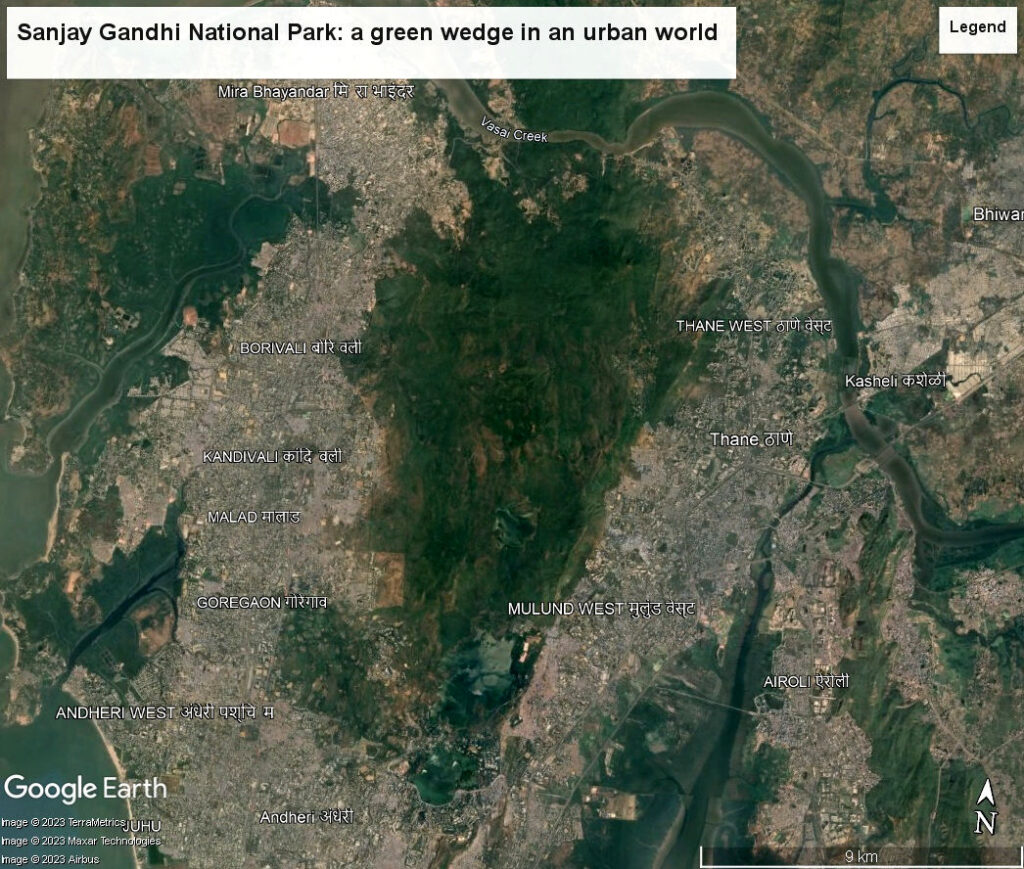
Surve, Nikit & Sambandam, Sathyakumar & Sankar, Kalyanasundaram & Jathanna, Devcharan & Gupta, Vikas & Athreya, Vidya. (2022). Leopards in the City: The Tale of Sanjay Gandhi National Park and Tungareshwar Wildlife Sanctuary, Two Protected Areas in and Adjacent to Mumbai, India. Frontiers in Conservation Science. 3. 787031.
Athreya, Vidya & Odden, Morten & Linnell, John & Karanth, K. (2010). Translocation as a Tool for Mitigating Conflict with Leopards in Human-Dominated Landscapes of India. Conservation biology : the journal of the Society for Conservation Biology. 25. 133-41.
Ranade, Pinak & Londhe, Sunil & Mishra, Asima & Bhatnagar, Pankaj. (2015). Geo-informatics approach to Human-Leopard Conflict in Urban Forest Areas -a Case review of Sanjay Gandhi National Park (SGNP), Borivali, Mumbai. International Journal of IT, Engineering and Applied Sciences Research (IJIEASR). 4. 2319-4413.
Punjabi GA, Athreya V, Linnell JDC. Using Natural Marks to Estimate Free-Ranging Dog Canis Familiaris Abundance in a Mark-Resight Framework in Suburban Mumbai, India. Tropical Conservation Science. 2012;5(4):510-520.
Braczkowski, Alexander, Christopher J. O’Bryan, Martin Stringer, James E. M. Watson, Hugh P. Possingham and Hawthorne L. Beyer. “Leopards provide public health benefits in Mumbai, India.” Frontiers in Ecology and the Environment 16 (2018): 176-182.
Music
Opening & Closing Themes: Running Waters and Acoustic Meditation by Audionautix (Jason Shaw), from audionautix.com. CC BY 3.0.
Modified versions of: $50 to Breathe, I Refuse to Accept That There’s Nothing I Can Do About It and Thanks for Trying to Rescue Me But You’ve Made Things Worse by Chris Zabriskie, CC BY 3.0