
The Cookiecutter Shark (Isistius brasiliensis) is famous for its gruesomely efficient parasitic attacks on whales, seals and big fish. But that is only a part of the story when it comes to this extraordinary, and extraordinarily bright, shark …
Subscribe to the Podcast and never miss a Wild Episode! (P.S. Make your friends and family subscribe too!)
If you want to support the podcast, and help keep it going, please share it on social media, and rate and review it (positively of course!) on your podcast app.
And please do E-mail the show if you have any comments, complaints, corrections, suggestions, encouragement or even just want to say hello.
And don’t forget, you can now check out The Wild Episode’s very own Facebook page. And, you can find and follow the show on Twitter!
Show notes below …
A Cookiecutter shark (Isistius brasiliensis), demonstrating its overall sort of cigar shape, and – just about – the odd dark collar around its neck:

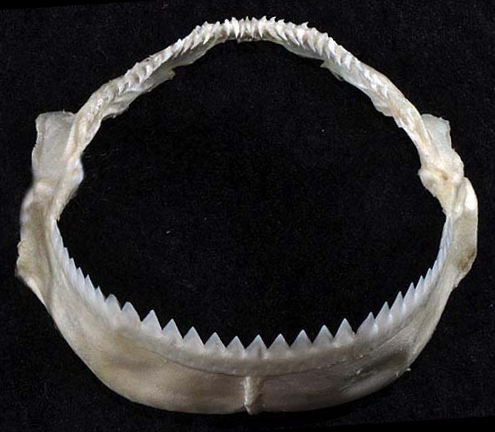
And, the jaws of a Cookiecutter shark, demonstrating the pretty normal upper teeth, the much more distinctive lower teeth:
We’ve got very little footage of live Cookiecutters in their natural habitat, but here’s some:
And – a little gruseome these next two, but relevant – evidence for cookiecutter shark attacks on a dolphin:
… and on a giant oarfish:
The news item that seeded this episode, about a newly discovered population of orcas in the Pacific: Orcas covered in scars left by ‘cookiecutter sharks’ may be new population, study says.
The Wikipedia page for the cookiecutter shark, Isistius brasiliensis, which this episode is about. And just for the sake of completeness, the page for the other species I mention: Isistius plutodus, the largetooth cookiecutter shark, which this episode is not so much about, because we know almost nothing specific about it.
A couple of items about cookiecutters attacking submarines and catamarans:
A Shark Wreaked Havoc on the US Navy’s Nuclear Submarine Fleet
Sharks in the Pacific: The Unprecedented Sinking of the Russian Ocean Way – TION
Science
Starting with the key 1971 paper that identified the cookiecutter shark as the cause of crater wounds:
Jones E. (1971) Isistius brasiliensis, a squaloid shark, the probable cause of crater wounds on fishes and cetaceans. Fish Bull Natl Ocean Atmos Adm.
And the autopsies of the stranded Melon-Headed whales I talk about early in the episode:
Bossart et al, Pathological Findings in a Rare Mass Stranding ofMelon-Headed Whales (Peponocephala electra) in Florida, Aquatic Mammals 2007, 33(2), 235-240
And the rest:
(This one requires a free JSTOR account to read) Strasburg, Donald W. “The Diet and Dentition of Isistius Brasiliensis, with Remarks on Tooth Replacement in Other Sharks.” Copeia 1963, no. 1 (1963): 33–40.
Shirai & Nakaya, Functional Morphology of Feeding Apparatus of the Cookie-CutterShark, Isistius brasiliensis (Elasmobranchii, Dalatiinae), ZOOLOGICAL SCIENCE 9: 811-821 (1992)
Widder, Edith. (1998). A predatory use of counterillumination by the squaloid shark, Isistius brasiliensis. Environmental Biology of Fishes. 53. 267-273.
Dwyer, Sarah L.. “Cookie Cutter Shark (Isistius sp.) Bites on Cetaceans, with Particular Reference to Killer Whales (Orca) (Orcinus orca).” Aquatic Mammals 37 (2011): 111-138.
Carlisle AB, Allan EA, Kim SL, Meyer L, Port J, Scherrer S, O’Sullivan J. Integrating multiple chemical tracers to elucidate the diet and habitat of Cookiecutter Sharks. Sci Rep. 2021 Jun 3;11(1):11809.
Papastamatiou, Yannis & Wetherbee, Bradley & O’Sullivan, John & Goodmanlowe, Gwen & Lowe, Christopher. (2010). Foraging ecology of Cookiecutter Sharks (Isistius brasiliensis) on pelagic fishes in Hawaii, inferred from prey bite wounds. Environmental Biology of Fishes. 88. 361-368
Ribéreau-Gayon, Agathe, Carolyn Rando, Yves Schuliar, Stéphane Chapenoire, Enrico R Crema, Julien M. Claes, Bernard Séret, Vincent Maleret and Ruth M. Morgan. “Extensive unusual lesions on a large number of immersed human victims found to be from cookiecutter sharks (Isistius spp.): an examination of the Yemenia plane crash.” International Journal of Legal Medicine 131 (2016): 423 – 432.
(Direct link tp PDF!) Honebrink, Randy & Buch, Robert & Galpin, Peter & Burgess, George. (2011). First Documented Attack on a Live Human by a Cookiecutter Shark (Squaliformes, Dalatiidae: Isistius sp.). Pacific Science. 65. 365-374.
Minaglia, Steven & Liegl, Melodee. (2024). Moonless night sky increases Isistius species (cookiecutter shark) and live human contact. PloS one. 19. e0291852.
Music
Opening & Closing Themes: Running Waters and Acoustic Meditation by Audionautix (Jason Shaw), from audionautix.com. CC BY 3.0.
Modified versions of: Icy Interlude [feat. Mystified], Uncertainty and Left Behind by Nova Beat Estate, CC BY 4.0; Lightless Dawn by Kevin Macleod (incompetech.com), CC BY 4.0.