
The Harlequin Beetle-Riding Pseudoscorpion: a tiny predator with an extraordinary way of moving from one hunting ground to the next …
You can support the show – keep it going, keep it growing – at The Wild Episode Substack. Become a paid subscriber there to get access to occasional bonus episodes. If you’d rather just stick with a free sign-up there, that’s fine: you’ll still get regular posts/e-mails celebrating the wonders and curiosities of the Animal Kingdom.
Feel free to E-mail the show if you have any comments, complaints, corrections, suggestions, encouragement or even just want to say hello.
Please do share the show on social media, and rate and review it (positively of course!) on your podcast app. That helps a lot. But best of all, of course, become a paid subscriber at The Wild Episode Substack.
And don’t forget, you can check out The Wild Episode’s very own Facebook page. And, you can check out Twitter and BlueSky.
Thank you!
Show notes below …
Here’s a female Harlequin beetle-riding pseudoscorpion (Cordylochernes scorpioides) producing nymphs:

Photo: By TEsInnovate – Own work, CC BY 4.0
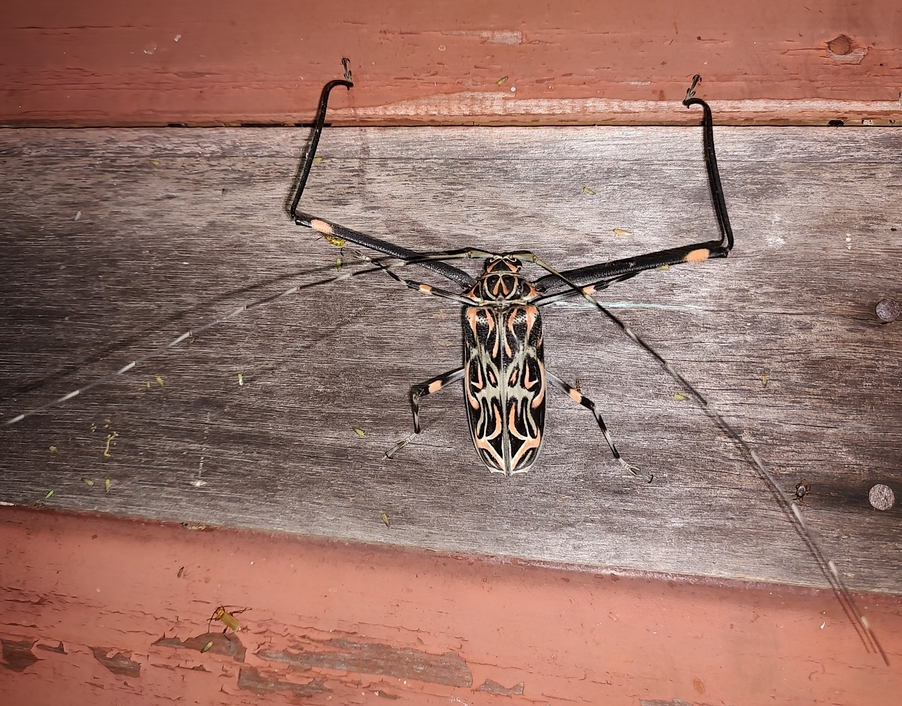
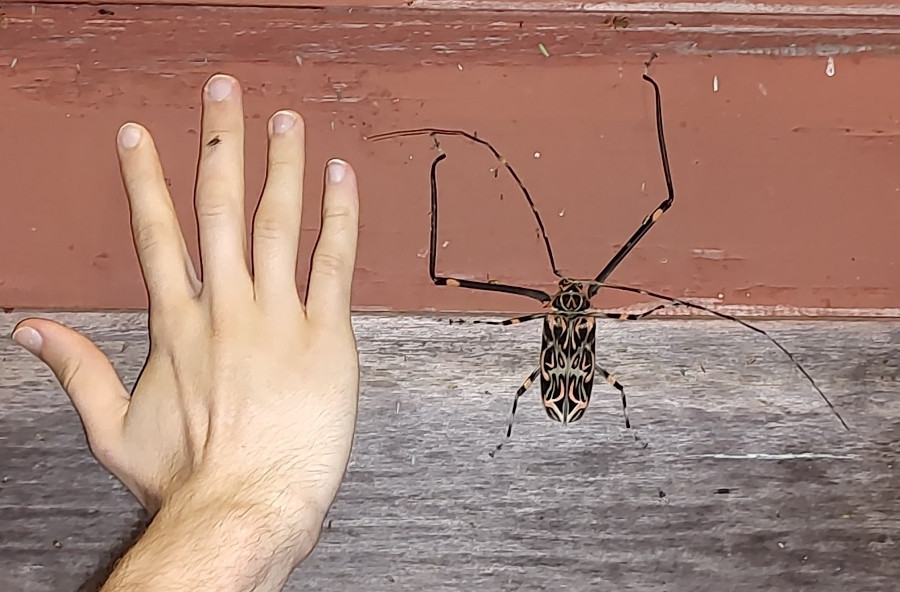
And here’s the magnificent Harlequin Beetle (Acrocinus longimanus) …
… with added hand for scale:
And here is what you sometimes see beneath the elytra of a Harlequin Beetle:
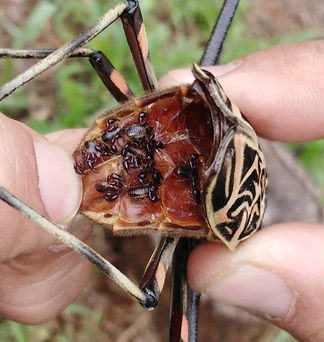
Photo: Julio Rod via iNaturalist, CC BY-NC 4.0
Lots of tiny hitch-hiking pseudoscorpions.
There’s a nice overview of Pseudoscoprions as a group, and their widespread habit of engaging in a bit of phoresy over at the Common Naturalist: Hitchhiking Pseudoscorpions (Phoresy)
Some science (you will notice certain names popping up again and again as authors – as is very common, its the long term effort of specific researchers that have given us most of what we know about this ecology):
Zeh, David W., and Jeanne A. Zeh. “On the Function of Harlequin Beetle-Riding in the Pseudoscorpion, Cordylochernes Scorpioides (Pseudoscorpionida: Chernetidae).” The Journal of Arachnology, vol. 20, no. 1, 1992, pp. 47–51.
Zeh, David & Zeh, Jeanne & Bermingham, Eldredge. (1997). Polyandrous, sperm-storing females: Carriers of male genotypes through episodes of adverse selection. Proceedings of The Royal Society B: Biological Sciences. 264. 119-125.
Opening & Closing Themes: Running Waters and Acoustic Meditation by Audionautix (Jason Shaw), from audionautix.com. CC BY 3.0.
Modified versions of: I Wanted to Live, You’re Enough and Slow Lights by Lee Rosevere, CC BY 3.0