The Giant Clam (Tridacna gigas) has a secret trick that enables it to grow faster and bigger than any other bivalve mollusc in the world …
You can support the show – keep it going, keep it growing – at The Wild Episode Substack. Become a paid subscriber there to get access to occasional bonus episodes. If you’d rather just stick with a free sign-up there, that’s fine: you’ll still get regular posts/e-mails celebrating the wonders and curiosities of the Animal Kingdom.
Feel free to E-mail the show if you have any comments, complaints, corrections, suggestions, encouragement or even just want to say hello.
Please do share the show on social media, and rate and review it (positively of course!) on your podcast app. That helps a lot. But best of all, of course, become a paid subscriber at The Wild Episode Substack.
And don’t forget, you can check out The Wild Episode’s very own Facebook page. And, you can check out Twitter and BlueSky.
Thank you!
Show notes below …
Tridacna gigas, not the only but the ‘iconic’ species of Giant Clam, sitting quietly on a reef:
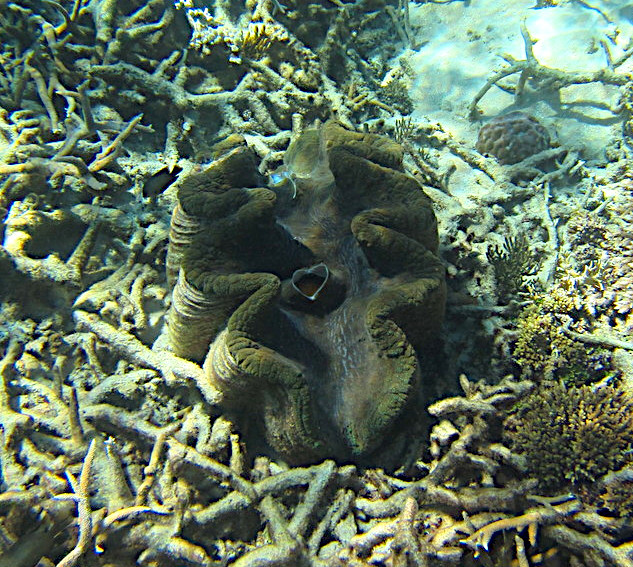
The brownish colour there is probably the sort of ‘baseline’ colour of the zooxanthellae that fill the mantle tissue. The species does come in other shades:
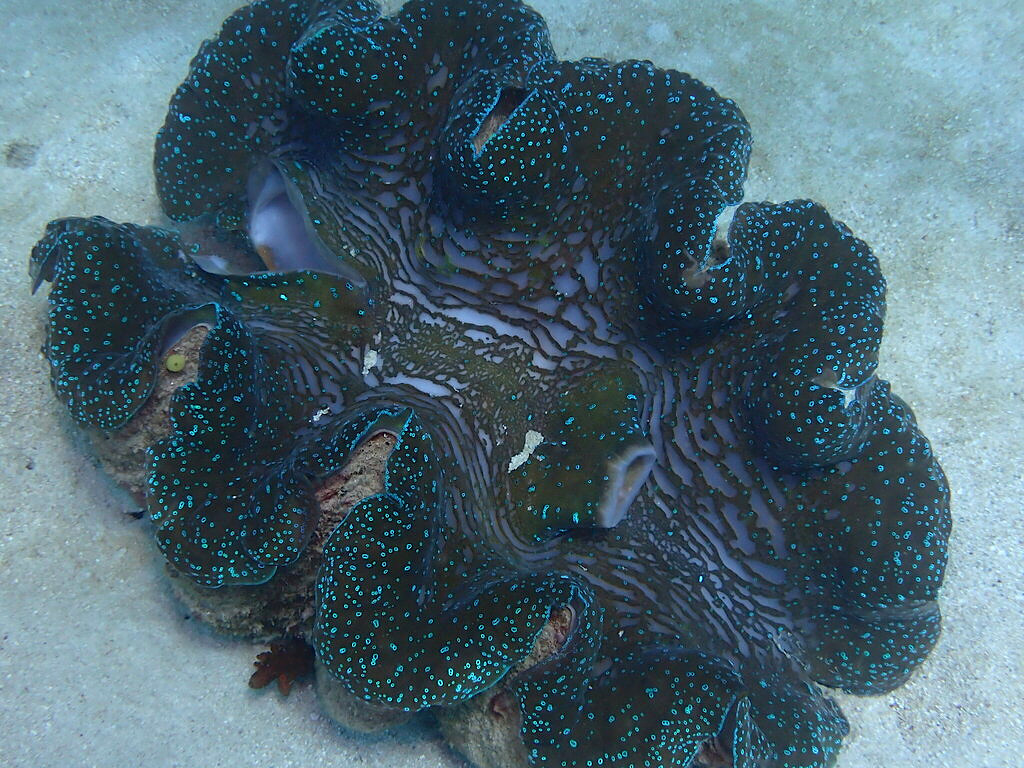
Photo: 呂一起(Lu i-chi) via iNaturalist, CC BY 4.0
For a very nice overview and discussion of giant clams in general, and Tridacna gigas in particular: The History, Myth, and Future of the Giant Clam at Atlas Obscura.
Also a great overview and introduction: Lucas, John S., Giant Clams, Current Biology, Volume 24, Issue 5, R183 – R184
For the size of Giant Clams (and a whole bunch of other marine giants): McClain CR, Balk MA, Benfield MC, Branch TA, Chen C, Cosgrove J, Dove AD, Gaskins L, Helm RR, Hochberg FG, Lee FB, Marshall A, McMurray SE, Schanche C, Stone SN, Thaler AD. Sizing ocean giants: patterns of intraspecific size variation in marine megafauna. PeerJ. 2015 Jan 13;3:e715. doi: 10.7717/peerj.715.
The IUCN RedList listing for Tridacna gigas, with details of distribution, ecology, threats, and so on.
More science:
Neo, Mei Lin & Eckman, William & Vicentuan, Kareen & Teo, Serena & Todd, Peter. (2014). The ecological significance of giant clams in coral reef ecosystems. Biological Conservation. 181. 111-123.
Soo P, Todd PA. The behaviour of giant clams (Bivalvia: Cardiidae: Tridacninae). Mar Biol. 2014;161(12):2699-2717.
Klumpp DW, Griffiths CL (1994) Contributions of phototrophic and heterotrophic nutrition to the metabolic and growth requirements of four species of giant clam (Tridacnidae) . Mar Ecol Prog Ser 115:103-115
Nanyu Zhao, Hong Yan, Yuanjian Yang, Chengcheng Liu, Xiaolin Ma, Guozhen Wang, Pengchao Zhou, Hanfeng Wen, Xiaoli Qu, John Dodson, A 23.7-year long daily growth rate record of a modern giant clam shell from South China Sea and its potential in high-resolution paleoclimate reconstruction, Palaeogeography, Palaeoclimatology, Palaeoecology, Volume 583, 2021, 110682
Fisher, Charles R., et al. “Photosynthesis and Respiration in Tridacna Gigas as a Function of Irradiance and Size.” Biological Bulletin, vol. 169, no. 1, 1985, pp. 230–45.
(Needs a free account at JSTOR, this one) Klumpp, D. W., and C. L. Griffiths. “Contributions of Phototrophic and Heterotrophic Nutrition to the Metabolic and Growth Requirements of Four Species of Giant Clam (Tridacnidae).” Marine Ecology Progress Series, vol. 115, no. 1/2, 1994, pp. 103–15.
Music
Opening & Closing Themes: Running Waters and Acoustic Meditation by Audionautix (Jason Shaw), from audionautix.com. CC BY 3.0.
Modified versions of: DeepSpace by Audionautix (Jason Shaw), CC BY 3.0; Tired of Life, Please Wake Up and Away by Meydän, CC BY 4.0