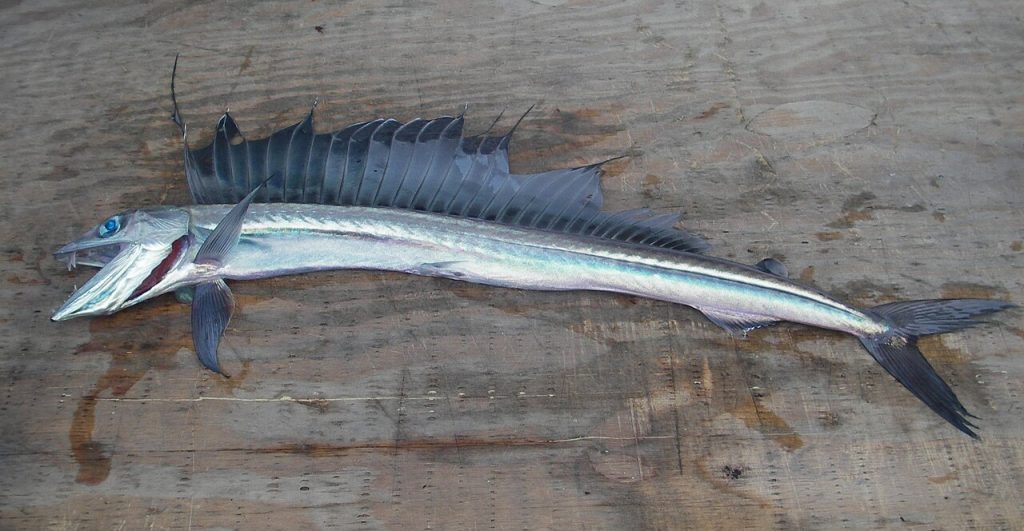
The Longnose Lancetfish (Alepisaurus ferox) is a big, strange, predatory fish of the open ocean, whose unusual feeding habits and physiology make it of particular interest to scientists …
You can support the show – keep it going, keep it growing, show you value it – at The Wild Episode Substack. Become a paid subscriber there to get access to occasional bonus episodes and to keep the show on the road. Even as a free subscriber, you’ll still get regular posts/e-mails celebrating the wonders and curiosities of the Animal Kingdom.
Feel free to E-mail the show if you have any comments, complaints, corrections, suggestions, encouragement or even just want to say hello.
Please do share the show on social media, and rate and review it on your podcast app. That helps a lot. But best of all, of course, become a paid subscriber at The Wild Episode Substack.
Neither me nor the show is terribly active on social media, but you can check out The Wild Episode’s very own Facebook page. And, I’m on BlueSky.
Thank you!
Show notes below …
The Longnose Lancetfish (Alepisaurus ferox):
There is, unfortunately, very little available footage of lancetfish alive in their natural environment, but there’s a little bit here (along with much more stuff about dissecting out their stomachs):
More details on both the lancetfish and its importance in scientific research here at the NOAA website: How an Odd, Cannibalistic Fish Is Helping Us Understand the Mysteries of the Deep
And an overview of the biology and ecology of the species here at Animal Diversity Web: Alepisaurus ferox (Handsaw fish). Not actually seen it called the ‘Handsaw fish’ elsewhere, but you can kind of see where the name comes from, with the long, low sailfin and all.
There is, unsurprisingly given the significance of these fish, a lot of scientific research I could link to here, so this is very much just some examples to get you started if you want to know more:
Romanov, Evgeny & Zamorov, Veniamin. (2007). Regional Feeding Patterns of the Longnose Lancetfish (Alepisaurus ferox Lowe, 1833) of the Western Indian Ocean. Western Indian Ocean Journal of Marine Science. 6. 37-56.
Choy, Anela & Portner, Elan & Iwane, Mia & Drazen, Jeffrey. (2013). Diets of five important predatory mesopelagic fishes of the central North Pacific. Marine Ecology Progress Series. 492. 169-184.
Elan J. Portner, Jeffrey J. Polovina, C. Anela Choy, Patterns in micronekton diversity across the North Pacific Subtropical Gyre observed from the diet of longnose lancetfish (Alepisaurus ferox), Deep Sea Research Part I: Oceanographic Research Papers, Volume 125, 2017, Pages 40-51
Portner, E.J., Mowatt-Larssen, T., Carretero, A.CL. et al. Harnessing a mesopelagic predator as a biological sampler reveals taxonomic and vertical resource partitioning among three poorly known deep-sea fishes. Sci Rep 13, 16078 (2023).
(Direct link to Thesis PDF) Ellyn Willse. 2022. Trophic Ecology of a Dominant Mesopredatory Fish Family (Alepisauridae) in the Western North Atlantic Revealed by Stomach Content and Stable Isotope Analysis. Master’s thesis. Nova Southeastern University.
Mao Kuroda, Keiichi Uchida, Toshihide Kitakado, Daisuke Shiode, Masao Nemoto, Yoshinori Miyamoto, Hideshige Takada, Rei Yamashita, Hiroaki Hamada, Ryuichi Hagita, Hiroki Joshima, Yuta Yamada,
Relationship between ocean area and incidence of anthropogenic debris ingested by longnose lancetfish (Alepisaurus ferox), Regional Studies in Marine Science, Volume 55, 2022, 102476
Chen, Rachel & Paulson, Erik & Schartup, Amina & Choy, Anela. (2025). Diet shifts drive mercury bioaccumulation and distribution in tissues of the longnose lancetfish (Alepisaurus ferox). Marine pollution bulletin. 213. 117590
Music
Opening & Closing Themes: Running Waters and Acoustic Meditation by Audionautix (Jason Shaw), from audionautix.com. CC BY 3.0.