The most numerous purely terrestrial animal in Antarctica is almost certainly the nematode worm Scottnema lindsayae. An astonishingly resilient little creature that goes places almost no other animal can, and probably rides the wind to get there …
Subscribe to the Podcast and never miss a Wild Episode! (P.S. Make your friends and family subscribe too!)
If you want to support the podcast, and help keep it going, please share it on social media, and rate and review it (possitively of course!) on your podcast app.
And please do E-mail the show if you have any comments, complaints, corrections, suggestions, encouragement or even just want to say hello.
And don’t forget, you can now check out The Wild Episode’s very own Facebook page. And, you can find and follow the show on Twitter!
Show notes available below …
Fantastic short video here, introducing Scottnema lindsayae and, I think, conveying the passion of a working scientist rather well. Personally, I agree with him, it’s a thing of beauty:
And here’s some stunning time-lapse footage of the almost surreal McMurdo Dry Valleys:
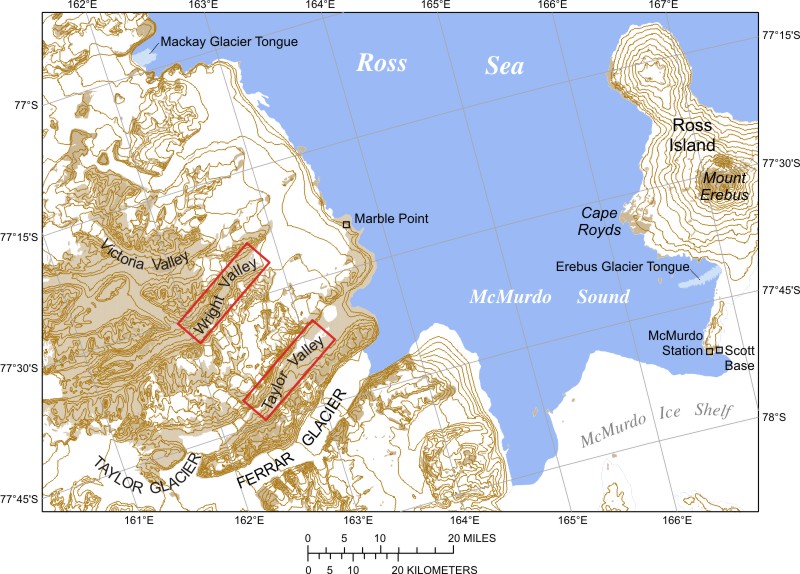
A map of Mcmurdo Sound, showing the Dry Valleys over on the left (west) there. Mcmurdo Station, and the point from which Robert Scott set out on his doomed journey to the South Pole, hundreds of miles south of here, are at the lower right of the Sound:
The Wikipedia page on the McMurdo Dry Valleys is a decent overview of this extraordinary place.
And you can get a feel for the diversity (or otherwise) of Antatrctic microfauna, including nematodes, from the wikipedia page Antarctic micro-organism.
Before going into sciencey stuff, I should say that something I ommitted from the episode – possibly mistakenly – for reasons of time and length, were the potential implications of climate change for Scottnema. Tldr is that they’re not great. They’re rather well summarised here: Climate change imperils tiny animal in the world’s most extreme continent (Mongabay)
The figures for global nematode abundance, particularly in soil, come from here:
van den Hoogen, J., Geisen, S., Routh, D. et al. Soil nematode abundance and functional group composition at a global scale. Nature 572, 194–198 (2019).
Some of the science on Scottnema and its ecosystem:
Ross A. Virginia, Diana H. Wall, How Soils Structure Communities in the Antarctic Dry Valleys, BioScience, Volume 49, Issue 12, December 1999, Pages 973–983
Caruso, T., Hogg, I.D., Nielsen, U.N. et al. Nematodes in a polar desert reveal the relative role of biotic interactions in the coexistence of soil animals. Commun Biol 2, 63 (2019).
Boström, S., Holovachov, O. & Nadler, S.A. Description of Scottnema lindsayae Timm, 1971 (Rhabditida: Cephalobidae) from Taylor Valley, Antarctica and its phylogenetic relationship. Polar Biol 34, 1–12 (2011).
Adams, Byron & Wall, Diana & Gozel, Ugur & Dillman, Adler & Chaston, J. & Hogg, Ian. (2007). Adams B, Wall D, Gozel U, Dillman, Chaston, Hogg I.. The southernmost worm, Scottnema lindsayae (Nematoda): diversity, dispersal and ecological stability. Polar Biol 30: 809-815.
Zawierucha, K., Marshall, C.J., Wharton, D.A., & Janko, K. (2019). A nematode in the mist: Scottnema lindsayae is the only soil metazoan in remote Antarctic deserts, at greater densities with altitude. Polar Research.
Courtright EM, Wall DH, Virginia RA, Frisse LM, Vida JT, Thomas WK. Nuclear and Mitochondrial DNA Sequence Diversity in the Antarctic Nematode Scottnema lindsayae. J Nematol. 2000 Jun;32(2):143-53.
Nkem, J.N., Wall, D.H., Virginia, R.A. et al. Wind dispersal of soil invertebrates in the McMurdo Dry Valleys, Antarctica. Polar Biol 29, 346–352 (2006).
Music
Opening & Closing Themes: Running Waters and Acoustic Meditation by Audionautix (Jason Shaw), from audionautix.com. CC BY 3.0.
Modified versions of: Iced Spring Theme and The Fall by Peter Rudenko, CC BY 4.0 and CC BY 3.0 respectively.