The Whirling Disease Myxozoan (Myxobolus cerebralis) is a tiny parasitic organism that, sometimes, causes severe disease in certain salmon and trout species. There’s a lot that’s amazing about it, but two particular questions with amazing answers for this episode: Just how tiny is tiny? and What type of organism are we talking about here?
Subscribe to the Podcast and never miss a Wild Episode! (P.S. Make your friends and family subscribe too!)
If you want to support the podcast, and help keep it going, please share it on social media, and rate and review it (possitively of course!) on your podcast app.
And please do E-mail the show if you have any comments, complaints, corrections, suggestions, encouragement or even just want to say hello.
And don’t forget, you can now check out The Wild Episode’s very own Facebook page. And, you can find and follow the show on Twitter!
Show notes below …
Here’s a nice simple summary of the overall life cycle of Myxobolus cerebralis:

And an image (vastly magnified, obviously!) of the ‘grappling hook’ style spore I talk about in the episode:
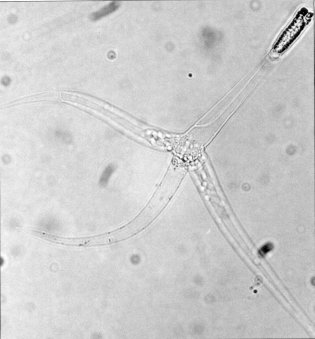
Which maybe isn’t super-informative, but here’s a helpful labelled drawing that might clarify slightly:

A nice video that serves as a sort of general introduction to Myxozoans, but specifically talks about the intriguing shrinkage and simplification that has characterised their evolution:
Nice text overview of the whole group of Myxozoa at the Encyclopedia of Arkansas Myxozoans page.
And for an overview of Myxobolus cerebralis itself, you can do worse than the relevant Wikipedia page (although as often with parasites, it’s as much focused on the disease – Whirling Disease – as it is the cool animal; and, slightly bizarrely, it has essentially zero references to verify its statements and help with further research).
But to be honest, if you really want to get to grips with the wondrous world of Myxozoans, there’s actually loads of pretty comprehensive sources – of varying degrees of technicality – freely available. Such as:
Okamura, B., Gruhl, A., Bartholomew, J.L. (2015). An Introduction to Myxozoan Evolution, Ecology and Development. In: Okamura, B., Gruhl, A., Bartholomew, J. (eds) Myxozoan Evolution, Ecology and Development. Springer, Cham.
The best summary of the historical aspects of Whirling Disease I found was this:
Bartholomew, Jerri & Reno, P.W.. (2002). The history and dissemination of whirling disease. American Fisheries Society Symposium. 2002. 3-24.
And I don’t normally link to articles that aren’t easily and very obviously publicly available in these show notes, but since I specifically quoted this paper in the episode – and because it is freely available if you sign up for a free account with JSTOR like I have – I should mention:
Wolf, Ken, and Maria E. Markiw. “Biology Contravenes Taxonomy in the Myxozoa: New Discoveries Show Alternation of Invertebrate and Vertebrate Hosts.” Science, vol. 225, no. 4669, 1984, pp. 1449–52.
And in the same spirit, you can read, via JSTOR, the 1990s paper I mention that came out really strongly in favour of Myxozoa as Cnidarians:
Siddall, Mark E., et al. “The Demise of a Phylum of Protists: Phylogeny of Myxozoa and Other Parasitic Cnidaria.” The Journal of Parasitology, vol. 81, no. 6, 1995, pp. 961–67.
Other scientific stuff, available without having to sign up for anything:
Chang, E. & Neuhof, Moran & Rubinstein, Nimrod & Diamant, Arik & Phillipe, Herve & Huchon, Dorothee & Cartwright, Paulyn. (2015). Genomic insights into the evolutionary origin of Myxozoa within Cnidaria. Proceedings of the National Academy of Sciences. 112.
Nesnidal, Maximilian & Helmkampf, Martin & Bruchhaus, Iris & El-Matbouli, Mansour & Hausdorf, Bernhard. (2013). Agent of Whirling Disease Meets Orphan Worm: Phylogenomic Analyses Firmly Place Myxozoa in Cnidaria. PloS one. 8. e54576.
Holzer, Astrid & Sojková (Bartošová), Pavla & Born-Torrijos, Ana & Lövy Kodádková, Alena & Hartigan, Ashlie & Fiala, Ivan. (2018). The joint evolution of the Myxozoa and their alternate hosts: A cnidarian recipe for success and vast biodiversity. Molecular Ecology. 27.
Hedrick, R.P. & El-Matbouli, Mansour. (2002). Recent advances with taxonomy, life cycle, and development of Myxobolus cerebralis in the fish and oligochaete hosts. American Fisheries Society Symposium. 2002. 45-53.
Music
Opening & Closing Themes: Running Waters and Acoustic Meditation by Audionautix (Jason Shaw), from audionautix.com. CC BY 3.0.
Modified versions of: On The Highway, Age, Angled Insight and Unforeseen Space by Unheard Music Concepts, CC BY 4.0