
The tentacled snake (Erpeton tentaculatum) is one of the most unmistakable snakes in the world. And the story of how its tentacles connect to its extraordinary hunting strategy involves two letters: ‘J’ and ‘C’.
Subscribe to the Podcast and never miss a Wild Episode! (P.S. Make your friends and family subscribe too!)
If you want to support the podcast, and help keep it going, please share it on social media, and rate and review it (positively of course!) on your podcast app.
And please do E-mail the show if you have any comments, complaints, corrections, suggestions, encouragement or even just want to say hello.
And don’t forget, you can now check out The Wild Episode’s very own Facebook page. And, you can find and follow the show on Twitter!
Show notes below …
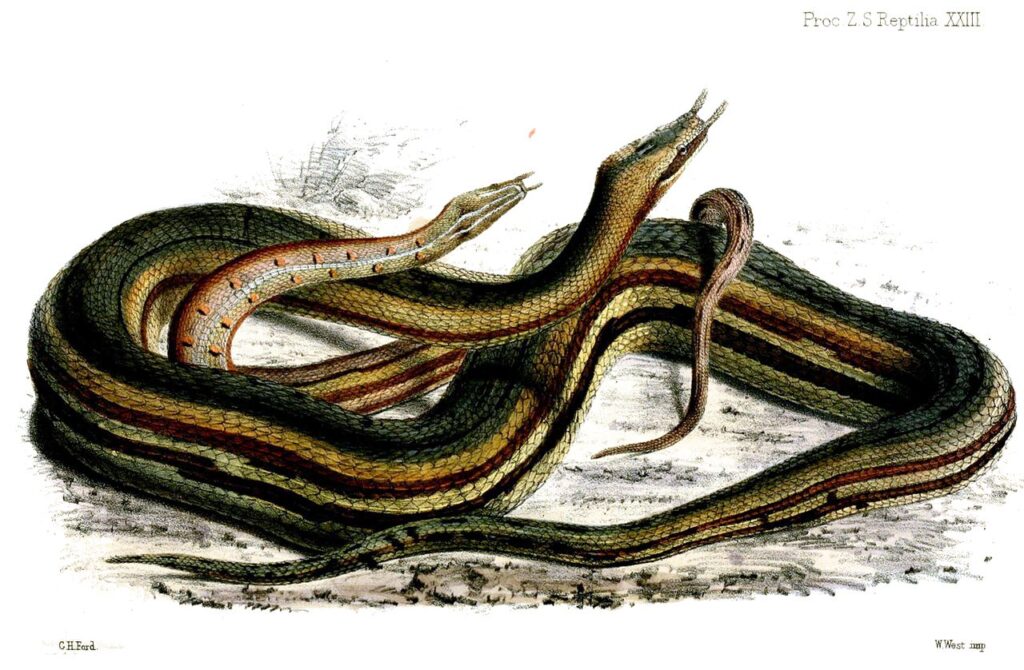
A 19th century illustration of the Tentacled snake (Erpeton tentaculatum):
But to be honest, I shouldn’t really be starting with anything other than with this amazing video. The tentacled snake in a laboratory setting, filmed striking at fish in slow motion. Absolutely unambiguous in what you can see when the film is slowed down: everything I talk about in the episode basically, from the initial twitch of the snake’s body to the C-start curve of the fish’s body, to the fact that snake is clearly shown to be striking at where the fish will be, not where it is when the strike starts. Just an awesome bit of scientific filming this, I think:
And, using some of that same research footage, a pretty accessible basic introduction to what’s going on:
For the record, that film, and a great deal of what we know about the tentacled snake’s hunting behaviour and its basis in neurology comes basically from one guy: Kenneth Catania, a biologist who’s done and/or led some absolutely fascinating work on some absolutely fascinating animals, which is outlined at the Catania Lab page. Anyway, the name ‘Catania’ will be appearing quite a bit in the references below – ubiquitously, in fact!
First, though, some slightly more general info:
For an introduction to the C-Start reflex and Mauthner cells, you can do worse than the relevant Wikipedia page. Got to say, it’s a huge topic, though, and gets quite complicated quite fast. A good, not too technical, overview is here, readable online: Sillar KT. Mauthner cells. Curr Biol. 2009 May 12;19(9):R353-5.
This, by the way, is Ludwig Mauthner himself, the discoverer of the cells in question:

For an overview of and intro to Homalopsid snakes as a whole – the family the tentacled snake belongs to – you can’t do much better than this: Murphy, John. (2007). Homalopsid Snakes. Evolution in the Mud. It’s basically a whole short book, available as a pdf at that link, but it’s worth a look, if you ask me. The Homalopsids are a cool and unusual bunch of snakes, doing various cool and unusual things.
On to some of the more technical references:
Catania KC. Tentacled snakes turn C-starts to their advantage and predict future prey behavior. Proc Natl Acad Sci U S A. 2009 Jul 7;106(27):11183-7.
K. C. Catania, D. B. Leitch, D. Gauthier; Function of the appendages in tentacled snakes (Erpeton tentaculatus). J Exp Biol 1 February 2010; 213 (3): 359–367.
Catania KC. Born knowing: tentacled snakes innately predict future prey behavior. PLoS One. 2010 Jun 16;5(6):e10953.
Catania KC. Evolution of brains and behavior for optimal foraging: a tale of two predators. Proc Natl Acad Sci U S A. 2012 Jun 26;109 Suppl 1(Suppl 1):10701-8.
Music
Opening & Closing Themes: Running Waters and Acoustic Meditation by Audionautix (Jason Shaw), from audionautix.com. CC BY 3.0.
Modified versions of: New Year’s Loops by Correspondence, CC BY 3.0, Wants To Know by Bodysurfer, CC BY 3.0, Piano Soundtrack 1 by Gurdonark, CC BY 3.0