
The Antarctic Krill (Euphausia superba) is one of the most numerous animals on Earth, probably responsible for the biggest single species aggregations you can find nowadays. So numerous, in fact, that its surprising connection to Antarctic sea ice is just one of the ways it’s bound into global climatic systems, carbon cycling and flows of energy and matter …
Subscribe to the Podcast and never miss a Wild Episode! (P.S. Make your friends and family subscribe too!)
If you want to support the podcast, and help keep it going, please share it on social media, and rate and review it (positively of course!) on your podcast app.
And please do E-mail the show if you have any comments, complaints, corrections, suggestions, encouragement or even just want to say hello.
And don’t forget, you can now check out The Wild Episode’s very own Facebook page. And, you can find and follow the show on Twitter!
Show notes below …
There are just vast amounts of information about Euphausia superba available on the internet, so here is just the tiniest sample to get you started:
The Strange Climate and Ice Conditions of 2023
Antarctic sets a record low maximum by wide margin from the National Snow and Ice Data Center.
Antarctic sea ice levels dive in ‘five-sigma event’, as experts flag worsening consequences for planet from abc.net.au
The mystery of the missing Antarctic sea ice from the British Antarctic Survey.
The Rocky Mountain Locust, mega-swarm and extinction
Here is the doomed Rocky Mountain locust (Melanoplus spretus) itself:
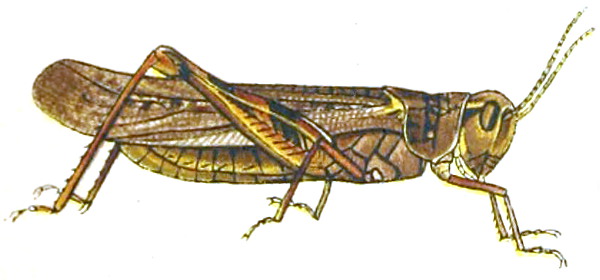
The relevant Wikipedia page has a good overview of the history of its rise and fall.
The currently (as far as I can work out) favoured explanation for how this insanely abundant insect went extinct so quickly is more or less covered in this article by its leading proponent: The death of the Super Hopper (by Jeffrey Lockwood) from High Country News.
Antarctic Krill and Sea Ice
Just a tiny selection of the enormous scientific literature on Euphausia superba:
Nowacek DP, Friedlaender AS, Halpin PN, Hazen EL, Johnston DW, Read AJ, et al. (2011) Super-Aggregations of Krill and Humpback Whales in Wilhelmina Bay, Antarctic Peninsula. PLoS ONE 6(4): e19173
Stretch, JJ & Hamner, PP & Hamner, WM & Michel, WC & Cook, J & Sullivan, Cornelius. (1988). Foraging behavior of Antarctic krill Euphausia superba on sea ice microalgae. Marine Ecology-progress Series – MAR ECOL-PROGR SER. 44. 131-139
Siegel, V. & Loeb, Valerie. (1995). Recruitment of Antarctic krill Euphausia superba and possible causes for its variability. Marine Ecology-progress Series – MAR ECOL-PROGR SER. 123. 45-56.
Flores H, van Franeker JA, Siegel V, Haraldsson M, Strass V, Meesters EH, et al. (2012) The Association of Antarctic Krill Euphausia superba with the Under-Ice Habitat. PLoS ONE 7(2): e31775.
Meyer, B. (2011): The overwintering of Antarctic krill, Euphausia superba, from an ecophysiological perspective , Polar Biology, 35 (1), pp. 15-37 .
Kohlbach, D., Lange, B.A., Schaafsma, F.L., David, C.L., Vortkamp, M., Graeve, M., van Franeker, J.A., Krumpen, T., & Flores, H. (2017). Ice Algae-Produced Carbon Is Critical for Overwintering of Antarctic Krill Euphausia superba. Frontiers in Marine Science, 4.
Stephen Nicol, Krill, Currents, and Sea Ice: Euphausia superba and Its Changing Environment, BioScience, Volume 56, Issue 2, February 2006, Pages 111–120
Legendre, Louis & Ackley, Stephen & Dieckmann, Gerhard & Gulliksen, Bjørn & Horner, Rita & Hoshiai, Takao & Melnikov, Igor & Reeburgh, William & Spindler, Michael & Sullivan, Cornelius. (1992). Ecology of sea ice biota. Polar Biology. 12. 429-444.
Music
Opening & Closing Themes: Running Waters and Acoustic Meditation by Audionautix (Jason Shaw), from audionautix.com. CC BY 3.0.
Modified versions of:
Ambient Dream, Nightmare Designs and Dark Awakening by malictusmusic, CC BY 4.0
SCP-x2x and Symmetry by Kevin MacLeod (incompetech.com), CC BY 4.0