
Remipedes! Upside-down-swimming, venom-injecting, cave-dwelling amazingness. Some of the strangest crustaceans ever discovered, living in some of the strangest places the world has to offer.
Subscribe to the Podcast and never miss a Wild Episode! (P.S. Make your friends and family subscribe too!)
If you want to support the podcast, and help keep it going, please share it on social media, and rate and review it (positively of course!) on your podcast app.
And please do E-mail the show if you have any comments, complaints, corrections, suggestions, encouragement or even just want to say hello.
And don’t forget, you can now check out The Wild Episode’s very own Facebook page. And, you can find and follow the show on Twitter!
Show notes below …
Maybe this time the place to start is the place, not the animal:
Anchialine Caves and Their Ecology
Anchialine cave ecology by Thomas M Iliffe, 2000, in book: Ecosystems of the World. 30. Subterranean Ecosystems (pp.59-76) Editors: H. Wilkens, D.C. Culver, W.F. Humphreys
Calderón-Gutiérrez F, Sánchez-Ortiz CA, Huato-Soberanis L (2018) Ecological patterns in anchialine caves. PLoS ONE 13(11): e0202909.
But the best thing about anchialine cave systems is, of course, the amazing footage of cave diving:
Actually that’s not remotely true. The best thing about anchialine cave systems is, of course, remipedes! Genuinely enchanting, charismatic animals, I think:
An excellent image of a living remipede (Speleonectes tanumekes):
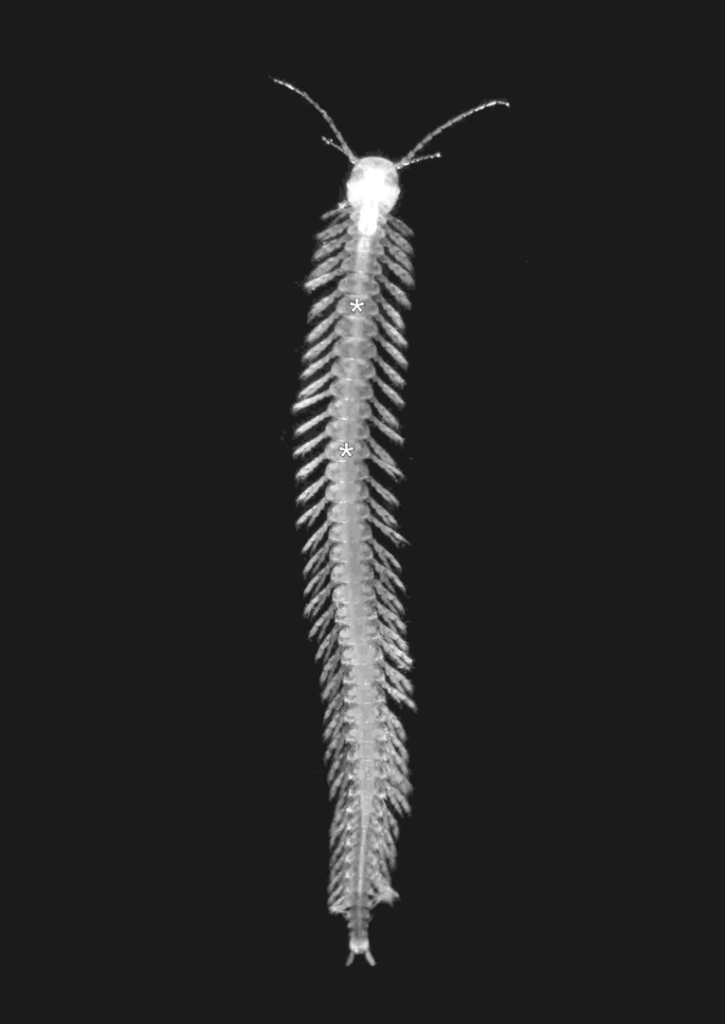
Photo: By Joris van der Ham from – Neiber, M. T., Hartke, T. R., Stemme, T., Bergmann, A., Rust, J., Iliffe, T. M., Koenemann, S. (2011). Global biodiversity and phylogenetic evaluation of Remipedia (Crustacea). PLoS ONE 6 (5): e19627, figure 1. CC BY 2.5.
I mention it in the episode, and it certainly is a good starting point for general info and a bunch of technical/taxonomic detail: The World Remipedia Database.
You can read about the original discovery of the fossil remipede Tesnusocaris goldichii with a free account at JSTOR: Brooks, H. K. “A Crustacean from the Tesnus Formation (Pennsylvanian) of Texas.” Journal of Paleontology 29, no. 5 (1955): 852–56.
And you don’t need an account of any sort to freely read about the discovery of the first known living remipede (Speleonectes lucayensis): Yager, Jill. (1981). Remipedia, A New Class of Crustacea From a Marine Cave in the Bahamas. Journal of Crustacean Biology. 1. 328.
Remipedes in Australia: Yager, Jill & Humphreys, William. (1996). Lasionectes exleyi, sp nov, the first Remipede crustacean recorded from Australia and the Indian Ocean, with a key to the world species. Invertebrate Systematics – INVERTEBR SYST. 10
Remipedes in the Canary Islands: Koenemann, Stefan & Bloechl, Armin & Martínez, Alejandro & Iliffe, Thomas & Hoenemann, Mario & Oromí, Pedro. (2009). A new, disjunct species of Speleonectes (Remipedia, Crustacea) from the Canary Islands. Mar Biodiv. 39. 215-225
Stefan Koenemann, Frederick R. Schram, Thomas M. Iliffe, Lara M. Hinderstein, Armin Bloechl, Behavior of Remipedia in the Laboratory, with Supporting Field Observations, Journal of Crustacean Biology, Volume 27, Issue 4, 1 October 2007, Pages 534–542
Yager, Jill. “The Remipedia (Crustacea): A Study of Their Reproduction and Ecology” (1989). Doctor of Philosophy (PhD), Dissertation, Biological Sciences, Old Dominion University.
Joris L. van der Ham, Bruce E. Felgenhauer, The Functional Morphology of the Putative Injecting Apparatus of Speleonectes Tanumekes (Remipedia), Journal of Crustacean Biology, Volume 27, Issue 1, 1 January 2007, Pages 1–9.
Björn M. von Reumont, Alexander Blanke, Sandy Richter, Fernando Alvarez, Christoph Bleidorn, Ronald A. Jenner, The First Venomous Crustacean Revealed by Transcriptomics and Functional Morphology: Remipede Venom Glands Express a Unique Toxin Cocktail Dominated by Enzymes and a Neurotoxin, Molecular Biology and Evolution, Volume 31, Issue 1, January 2014, Pages 48–58
Beyhan Ertas, Björn M. von Reumont, Johann-Wolfgang Wägele, Bernhard Misof, Thorsten Burmester, Hemocyanin Suggests a Close Relationship of Remipedia and Hexapoda, Molecular Biology and Evolution, Volume 26, Issue 12, December 2009, Pages 2711–2718
Bjoern M. von Reumont, Ronald A. Jenner, Matthew A. Wills, Emiliano Dell’Ampio, Günther Pass, Ingo Ebersberger, Benjamin Meyer, Stefan Koenemann, Thomas M. Iliffe, Alexandros Stamatakis, Oliver Niehuis, Karen Meusemann, Bernhard Misof, Pancrustacean Phylogeny in the Light of New Phylogenomic Data: Support for Remipedia as the Possible Sister Group of Hexapoda, Molecular Biology and Evolution, Volume 29, Issue 3, March 2012, Pages 1031–1045
Music
Opening & Closing Themes: Running Waters and Acoustic Meditation by Audionautix (Jason Shaw), from audionautix.com. CC BY 3.0.
Modified versions of: Short Song 030223, Short Song 022723 and Short Song 022523 by Chris Zabriskie, CC BY 4.0 ; cinematic suspense series episode 004 and lost place atmospheres 001 by Sascha Ende, CC BY 4.0.