
The Transvaal Thicktail Scorpion (Parabuthus transvaalicus) is a very unusual scorpion, with not only multiple venomous options when it comes to stinging, but also something very, very few scorpions have: a ranged attack.
You can support the show – keep it going, keep it growing, show you value it – at The Wild Episode Substack. Become a paid subscriber there to get access to occasional bonus episodes and to keep the show on the road. Even as a free subscriber, you’ll still get regular posts/e-mails celebrating the wonders and curiosities of the Animal Kingdom.
Feel free to E-mail the show if you have any comments, complaints, corrections, suggestions, encouragement or even just want to say hello.
Please do share the show on social media, and rate and review it on your podcast app. That helps a lot. But best of all, of course, become a paid subscriber at The Wild Episode Substack.
Thank you!
Show notes below …
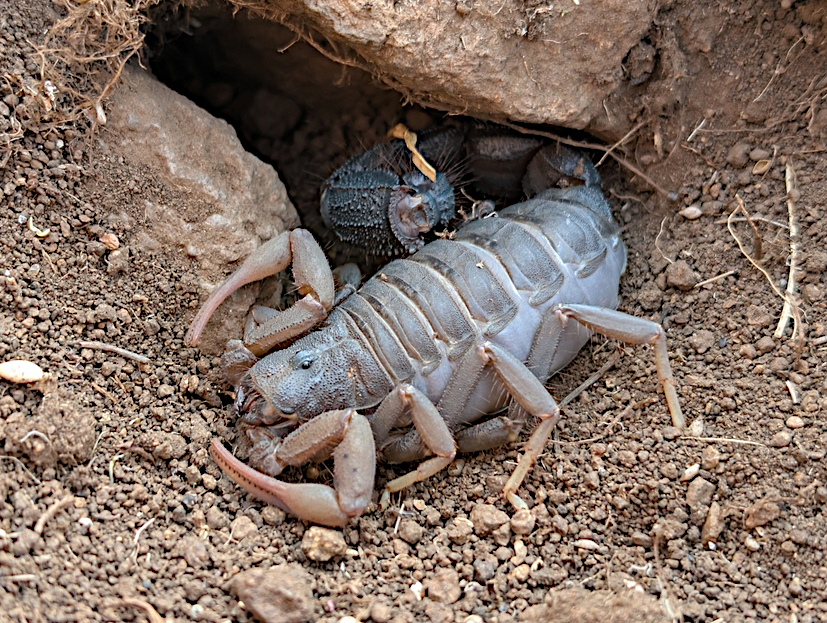
A Transvaal Thicktail Scorpion hanging out by its burrow:
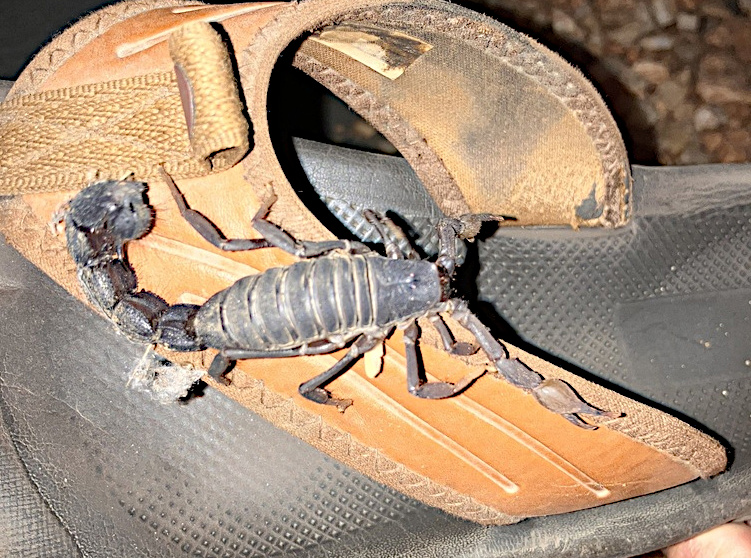
And one hanging out in the last place you want to see it, really – on your shoe:
And here it is spraying venom in a laboratory:
First, a pretty significant scientific paper – the most important and influential attempt to nail down proper biological definitions of venoms and poisons and the introduction of the idea of toxungens (Direct link to PDF): Nelsen, D.R., Nisani, Z., Cooper, A.M., Fox, G.A., Gren, E.C., Corbit, A., & Hayes, W.K. (2014). Poisons, toxungens, and venoms: redefining and classifying toxic biological secretions and the organisms that employ them. Biological Reviews, 89.
And a bit on the medical significance – and consequences – of the Transvaal thicktail scorpion stings in humans (Direct link to PDF): Tomlinson H, Elston DM. What’s eating you? the South African fattail scorpion revisited. Cutis. 2019 Oct;104(4):217-219
And an overview of how scorpions in general calibrate and control their venom use in response to predator and prey situations: Evans ERJ, Northfield TD, Daly NL and Wilson DT (2019) Venom Costs and Optimization in Scorpions. Front. Ecol. Evol. 7:196.
Moving on to stuff more specifically about the Transvaal Thicktail Scorpion and its distinctive habits and abilities …
Inceoglu B, Lango J, Jing J, Chen L, Doymaz F, Pessah IN, Hammock BD. One scorpion, two venoms: prevenom of Parabuthus transvaalicus acts as an alternative type of venom with distinct mechanism of action. Proc Natl Acad Sci U S A. 2003 Feb 4;100(3):922-7.
A whole PhD thesis, that basically contains a big chunk of what I talk about in the episode: Nisani, Zia, “Behavioral and Physiological Ecology of Scorpion Venom Expenditure: Stinging, Spraying, and Venom Regeneration” (2008). Loma Linda University Electronic Theses, Dissertations & Projects. 692.
Music
Opening & Closing Themes: Running Waters and Acoustic Meditation by Audionautix (Jason Shaw), from audionautix.com. CC BY 3.0.
Modified versions of: Soundwork XLVIII, Soundwork XLIII, Soundwork XL and Soundwork L by John Shuemaker, CC BY 4.0