
What is the biggest terrestrial animal native to Antarctica? It’s the Antarctic Midge (Belgica antarctica), a wingless fly that at no more than a quarter of an inch in length is by some distance Antarctica’s biggest pedestrian. This is life right on the edge of possibility …
Subscribe to the Podcast and never miss a Wild Episode! (P.S. Make your friends and family subscribe too!)
And please do E-mail the show if you have any comments, complaints, corrections, suggestions, encouragement or even just want to say hello.
And don’t forget, you can now check out The Wild Episode’s very own Facebook page.
Read on for more info in the shownotes …
Here we see two Antarctic midges in the process of making more Antarctic midges. Enjoying the sun and the light in that brief window of the southern summer when they’re actually adults and the environment is not insanely hostile.

And this is the kind of place where they have to live out their lives, larva and adult, year round – Paradise Bay, on the west coast of the Antarctic Peninsula:
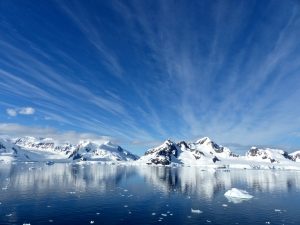
Quite the challenge, for an insect.
Miami University’s Laboratory for Ecophysiological Cryobiology (cool name!) has a nice, very brief intro to Belgica antarctica and a couple of other Antarctic invertebrates.
But by far the most comprehensive, if not totally up-to-date, easily available summary of what we know (or knew, in 1996) about the Antarctic midge is:
CONVEY & BLOCK, Antarctic diptera: Ecology, physiology and distribution, Eur. J. Entomol. 93 (1): 1-13, 1996. If you go here there’s a link to a pdf of the full paper underneath the summary. It’s a very interesting read!
Other stuff that may be of interest:
Open access paper on the genome of B. antarctica – Kelley JL, Peyton JT, Fiston-Lavier AS, et al. Compact genome of the Antarctic midge is likely an adaptation to an extreme environment. Nat Commun. 2014;5:4611. Published 2014 Aug 12.
Antarctic flies protect fragile eggs with ‘antifreeze’ reported over at phys.org.
And, not to end on a downer or anything, but here’s a newspaper report on how the combo of tourism, invasive species and climate change might spell trouble for Antarctica’s native fauna and flora: The latest threat to Antarctica: an insect and plant invasion.
Music
Opening & Closing Themes: Running Waters and Acoustic Meditation by Audionautix (Jason Shaw), from audionautix.com. CC BY 3.0.
Modified versions of the following pieces:
Running Free by BBATV. CC BY 4.0
Slow Dissolve and Crystal Waters by https://www.purple-planet.com