
The Great Northern Tilefish (Lopholatilus chamaeleonticeps) is a big, beautiful fish from the western Atlantic. It’s one of those rare animals that is capable of reshaping its physical environment over vast areas. But it’s also interesting for a rather unique reason. It was discovered, entirely accidentally, in 1879 and within 3 years of that discovery, something entirely unexpected and dramatic happened that involved millions upon millions of dead fish …
Subscribe to the Podcast and never miss a Wild Episode! (P.S. Make your friends and family subscribe too!)
And please do E-mail the show if you have any comments, complaints, corrections, suggestions, encouragement or even just want to say hello.
And don’t forget, you can now check out The Wild Episode’s very own Facebook page.
Read on for show notes: photos and plenty of further reading if you want to know more …
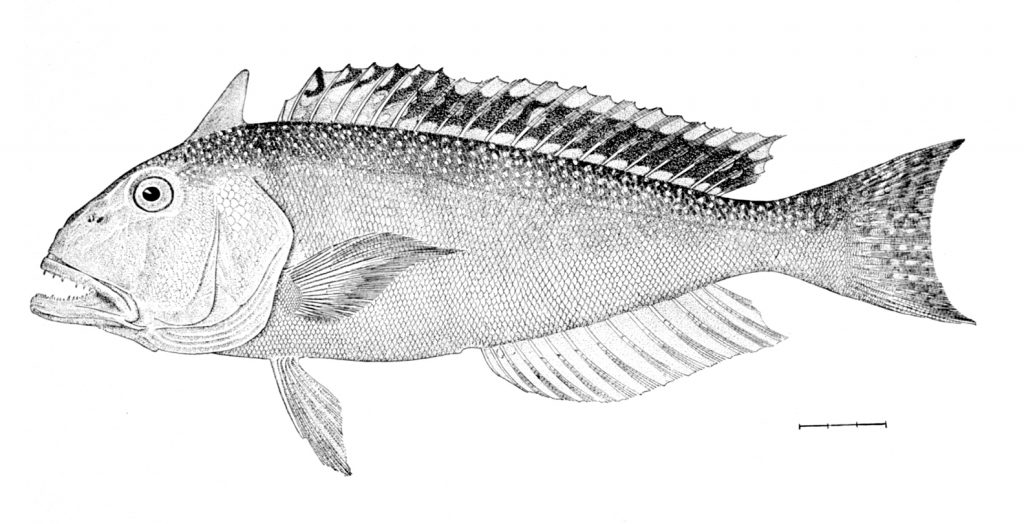
What the Great Northern Tilefish looks like in a line drawing:
… and in life …
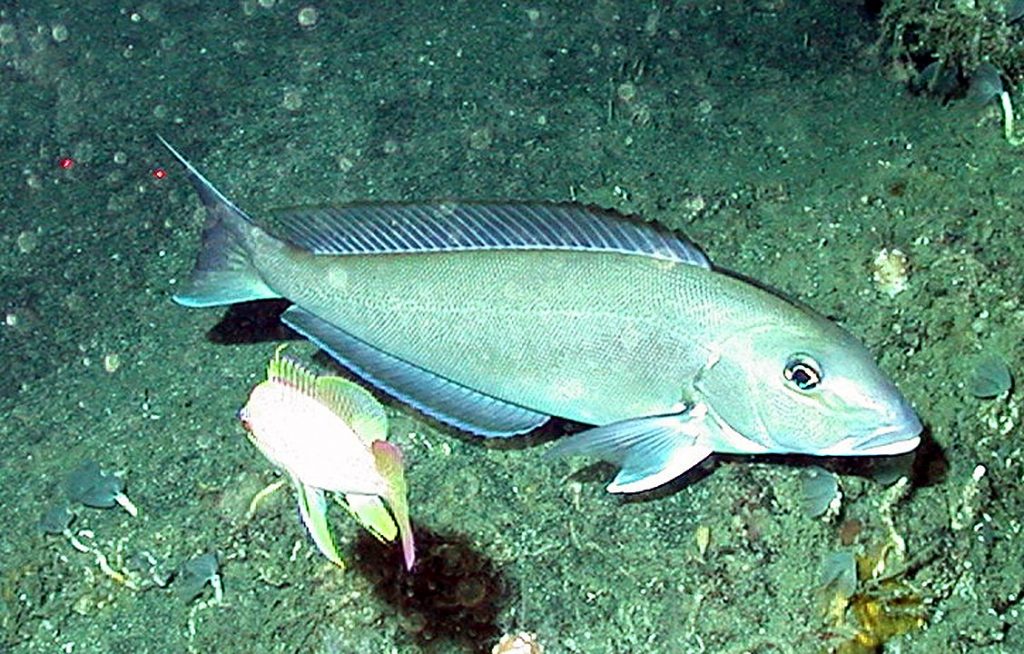
… and in a burrow (well, almost in a burrow)!:

You can get a PDF of the 1879 report that first described the Great Northern Tilefish (and told how it was discovered) here:
Goode, George Brown and Bean, Tarleton H. 1879. “Description of a new genus and species of fish, Lopholatilus chamaeleonticeps, from the south coast of New England.” Proceedings of the United States National Museum. 2 (77):205–209 (or you can read it on online at the Biodiversity Heritage Library if that works better for you).
And here’s a whole load of other stuff you can explore, covering the history, life, habits and significance of this species:
Steimle FW, Zetline CA, Berrien PL, Johnson DL, Chang S. 1999. Essential fish habitat source document: Tilefish, Lopholatilus chamaeleonticeps, life history and habitat characteristics. NOAA Tech Memo NMFS NE 152
Grimes, C. B., Able, K., & Jones, R. S. (1986). Tilefish, Lopholatilus chamaeleonticeps, habitat, behavior and community structure in Mid-Atlantic and southern New England waters. Environmental Biology of Fishes, 15(4)
Jonathan A. D. Fisher, Kenneth T. Frank, Brian Petrie, William C. Leggett, Life on the edge: environmental determinants of tilefish (Lopholatilus chamaeleonticeps) abundance since its virtual extinction in 1882, ICES Journal of Marine Science, Volume 71, Issue 9, November/December 2014
This is the paper making the case for the tilefish’s role in shaping the sea floor around the Hudson Canyon. I’ve read a PDF of it, but I’m afraid I’m now unable to find an accessible link for it!. You’ll have to follow your own nose if you want to get the full details, I’m afraid: Twichell, David & Grimes, Churchill & Jones, Robert & Able, Kenneth. (1985). The role of erosion by fish in shaping topography around Hudson submarine canyon. JOURNAL OF SEDIMENTARY RESEARCH. 55. 712-719.
And here’s the PDF of the key paper on the possible causes of the great tilefish kill of 1882: MARSH, ROBERT & PETRIE, BRIAN & WEIDMAN, CHRISTOPHER & DICKSON, ROBERT & Loder, John & Hannah, Charles & FRANK, KENNETH & Drinkwater, Kenneth. (1999). The 1882 tilefish kill – A cold event in shelf waters off the north-eastern United States?. Fisheries Oceanography. 8. 39 – 49.
There’s actually a ton of further reading available online about this species, but I won’t list it all here. A lot of it’s fishing-related, but contains plenty of interesting info if you really want to know more. A good place to start is, in this case, the relevant Wikipedia page which (for once) contains a lot of references and links down at the bottom to research and reports.
Music
Opening & Closing Themes: Running Waters and Acoustic Meditation by Audionautix (Jason Shaw), from audionautix.com. CC BY 3.0.
Modified versions of the following pieces:
Data by Mystery Mammal. CC BY 4.0