
The glacier ice worm Mesenchytraeus solifugus might look unremarkable, but it is an extraordinary animal. Above all, it’s extraordinary in where it lives: on and in glaciers. It is one of a tiny handful of non-microscopic animals that can not only tolerate but require glacial ice to survive …
Subscribe to the Podcast and never miss a Wild Episode! (P.S. Make your friends and family subscribe too!)
And please do E-mail the show if you have any comments, complaints, corrections, suggestions, encouragement or even just want to say hello.
And don’t forget, you can now check out The Wild Episode’s very own Facebook page. And, you can find and follow the show on Twitter!
Show notes below …
Celebrating the ice worm at the end of winter: The Cordova Ice Worm Festival
Concealing Cold War nuclear projects in Greenland: Project Iceworm
There aren’t that many great videos of ice worms in their natural habitat around, but to prove they’re real, here’re some sledders encountering them:
And although the sound quality on this one’s not great it does show very nicely that during the day, ice worms can be out and about in surface meltwater, but not on the exposed ice/snow right next door, because the water’s protecting them:
You can, should you so wish, read the entirety of ‘The Ascent of Mount St Elias‘ online, but this link’ll take you straight to Appendix D, where the ice worm was first scientifically described by Carlo Emery.
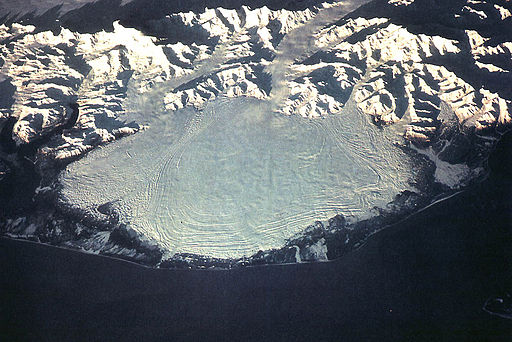
And this is what the Malaspina Glacier, where those worms were collected, looks like from space:
Here’s a phys.org article by Will Ferguson on the latest ice worm research: Unlocking Secrets of the Ice Worm.
And here’s a pretty good overview (although some of the image links seem to be broken) of ice worms at the North Cascade Glacier Climate Project.
On to scientific papers:
Roman J. Dial, Melissa Becker, Andrew G. Hope, Cody R. Dial, Joseph Thomas, Katarina A. Slobodenko, Trevor S. Golden & Daniel H. Shain (2016) The Role of Temperature in the Distribution of the Glacier Ice Worm, Mesenchytraeus solifugus (Annelida: Oligochaeta: Enchytraeidae), Arctic, Antarctic, and Alpine Research, 48:1, 199-211
Something I didn’t really get into much in the actual episode, but M. solifugus does, unsurprisingly, have some physical adaptations to life on glaciers, the technical details on which are laid out in a pdf you can download/access here: Shain, Daniel & Carter, Melissa & Murray, Kurt & Maleski, Karen & Smith, Nancy & McBride, Taresha & Michalewicz, Lisa & Saidel, Bill. (2000). Morphologic characterization of the ice worm Mesenchytraeus solifugus. Journal of Morphology – J MORPHOL. 246. 192-197.
Another one you can download a PDF for: Hartzell, Paula & Nghiem, Jefferson & Richio, Kristina & Shain, Daniel. (2011). Distribution and phylogeny of Glacier ice worms (Mesenchytraeus solifugus and Mesenchytraeus solifugus rainierensis). Canadian Journal of Zoology. 83. 1206-1213.
This one’s not just about ice worms, but is interesting on evolutionary history, biogeography etc. of it and its relatives: Shirley A. Lang, Naim Saglam, Joseph Kawash and Daniel H. Shain, 2017, Punctuated invasion of water, ice, snow and terrestrial ecozones by segmented worms (Oligochaeta: Enchytraeidae: Mesenchytraeus) Proc. R. Soc. B.28420171081
And here’s the most recent one, which includes the suggested involvement of migrating birds in ice worms moving from glacier to glacier: Scott Hotaling, Daniel H. Shain, Shirley A. Lang, Robin K. Bagley, Lusha M. Tronstad, David W. Weisrock and Joanna L. Kelley, 2019, Long-distance dispersal, ice sheet dynamics and mountaintop isolation underlie the genetic structure of glacier ice worms, Proc. R. Soc. B.28620190983
Music
Opening & Closing Themes: Running Waters and Acoustic Meditation by Audionautix (Jason Shaw), from audionautix.com. CC BY 3.0.
Modified versions of the following pieces:
Blue Lobster and Driving Through Tunnels by Daniel Birch. CC BY 4.0