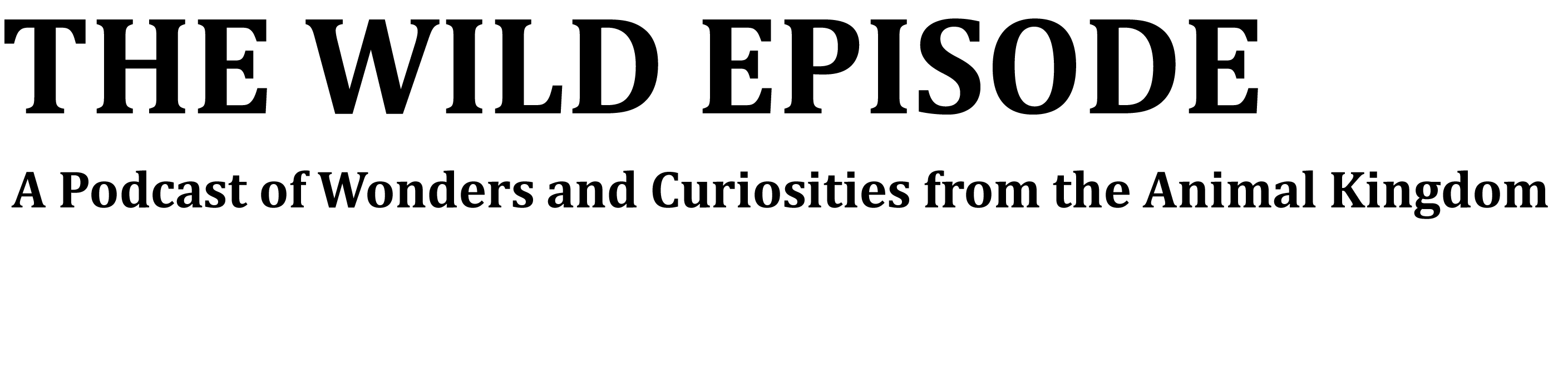
The Texas Horned Lizard (Phrynosoma cornutum) has solved a tricky problem: how to eat insects that not only have a powerful bite but also some of the most painful and lethal stings in the world …
You can support the show – keep it going, keep it growing – at The Wild Episode Substack. Become a paid subscriber to get access to occasional bonus episodes in future.
Please do E-mail the show if you have any comments, complaints, corrections, suggestions, encouragement or even just want to say hello.
And don’t forget, you can check out The Wild Episode’s very own Facebook page. And, you can check out Twitter and BlueSky.
Please do share the show on social media, and rate and review it (positively of course!) on your podcast app. That helps a lot. But best of all, of course, become a paid subscriber at The Wild Episode Substack. Thank you!
Show notes below …
For the two previous episodes in this short series inspired by The Schmidt Pain Index, see here: The Pain Index I – Bullet Ant and The Pain Index II – Tarantula Hawk.
The Texas horned lizard (Phrynosoma cornutum), showing off its spiky scales and the more dramatic actual horns adorning its head:

and showing off its notably rounded, flattened body shape – you can see why its sometimes called a horned toad:
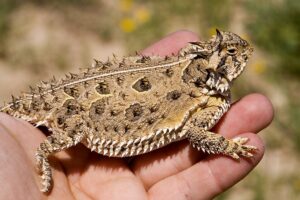
And of course we’ve got to have a quick look at a Texas horned lizard squirting blood from its eye:
Pretty comprehensive information about the Texas horned lizard over at Animal Diversity Web, which mentions quite a few cool things I didn’t have room for in the episode.
For completeness, here’re some Maricopa harvester ants (Pogonomyrmex maricopa):
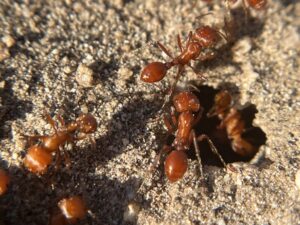
Just to get this out of the way, because it BUGS me, the entire internet really does keep saying that the Maricopa harvester ant is the insect with the most lethal venom in the world, and I find it a bit mystifying, because – as I say in the episode – Justin Schmidt himself very specifically reported that it is not. He reports the standard lethality (ld50) of 0.12 mg/kg for the Maricopa ant and greater lethality of 0.088 mg/kg for the related, but different, South American harvester ant Pogonomyrmex cunicularius in this 2019 paper (Direct Link to PDF): Schmidt, Justin. (2019). Predator–Prey Battle of Ecological Icons: Horned Lizards (Phrynosoma spp.) and Harvester Ants (Pogonomyrmex spp.). Copeia. 107. 404.
Unless there’s something I don’t know about (which is very possible!) the Maricopa harvester ant is not the world’s most venomous insect. Just saying.
The paper I mention in the episode that I can’t find a fully (legally) accessible copy of – so count it as potentially v. interesting but sort of out of reach – but can read the summary is this one: Wade C. Sherbrooke and Bruce A. Kimball “Antipredator Blood-Squirting Defense in Horned Lizards (Phrynosoma): Chemical Isolation of Plasma Component(s), Pogonomyrmex Ant Dietary Origin, and Evolution,” Ichthyology & Herpetology 112(1), 106-116, (22 March 2024).
Stuff that is fully accessible:
Schmidt, Patricia & Sherbrooke, Wade & Schmidt, Justin. (1989). The Detoxification of Ant (Pogonomyrmex) Venom by a Blood Factor in Horned Lizards (Phrynosoma). Copeia. 1989. 603
Fertschai I, Sherbrooke WC, Ott M, Chagnaud BP. Avoiding being stung or bitten – prey capture behaviors of the ant-eating Texas horned lizard (Phrynosoma cornutum). Biol Open. 2021 Mar 26;10(3)
Sherbrooke, Wade & Schwenk, Kurt. (2008). Horned lizards ( Phrynosoma ) incapacitate dangerous ant prey with mucus. Journal of experimental zoology. Part A, Ecological genetics and physiology. 309. 447-59
Sherbrooke, Wade. (1990). Rain-Harvesting in the Lizard, Phrynosoma cornutum: Behavior and Integumental Morphology. Journal of Herpetology. 24. 302.
Sherbrooke, Wade & Scardino, Andrew & de Nys, Rocky & Schwarzkopf, Lin. (2007). Functional morphology of scale hinges used to transport water: Convergent drinking adaptations in desert lizards (Moloch horridus and Phrynosoma cornutum). Zoomorphology. 126. 89-102.
Music
Opening & Closing Themes: Running Waters and Acoustic Meditation by Audionautix (Jason Shaw), from audionautix.com. CC BY 3.0.
Modified versions of: Doppler Piano by Mark Wilson X, CC BY 4.0; Freeze and Build by AvapXia, CC BY 4.0