The Pygmy Hippo. A species – one of them in particular – that’s been all over social media recently (shout-out to Moo Deng). But what do we actually know about this species, how do we know it and why is there something unusual about the baby pygmy hippos born in zoos around the world?
You can support the show – keep it going, keep it growing – at The Wild Episode Substack. Become a paid subscriber there to get access to occasional bonus episodes in future.
Feel free to E-mail the show if you have any comments, complaints, corrections, suggestions, encouragement or even just want to say hello.
Please do share the show on social media, and rate and review it (positively of course!) on your podcast app. That helps a lot. But best of all, of course, become a paid subscriber at The Wild Episode Substack.
And don’t forget, you can check out The Wild Episode’s very own Facebook page. And, you can check out Twitter and BlueSky.
Thank you!
Show notes below …
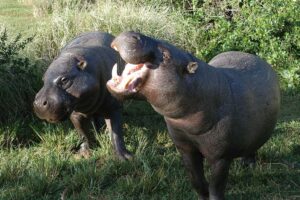
The undeniably charismatic and appealing Pygmy Hippopotamus (although you don’t want to get on the wrong end of those teeth):
I suppose there’s no avoiding a video of Moo Deng at this point:
BUT patriotically essential that I also highlight Edinburgh Zoo‘s most recent arrival, Haggis:
Enough frivolity. The known (poorly known, in truth, but suspected) range of the pygmy hippo in the wild:
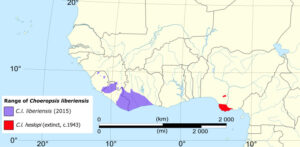
Image credit : By UndercoverClassicist – Own work, CC BY-SA 4.0
The red is a probably but not absolutely 100% certain, as far as I can work out, Nigerian sub-population that’s disappeared. The purple is probably the absolute best case scenario for where you might be able to find pygmy hippos in the wild today. Or recently, anyway.
The Pygmy Hippo page at the IUCN Red List gives a pretty substantial overview of what we know about the species, its conservation status (technically Endangered) and so on.
The most recent substantial single document collating the approximate state of knowledge about the species is this, as far as I know: Gabriella L Flacke, Jan Decher, Choeropsis liberiensis (Artiodactyla: Hippopotamidae), Mammalian Species, Volume 51, Issue 982, 6 December 2019, Pages 100–118
Got a lot of other stuff to link to here, so I’ll do it in sections.
The Pygmy Hippo in the Wild:
Hendier, Alba & Chatelain, Cyrille & Pasquier, Pierre‐Emmanuel & Paris, Monique & Ouattara, Karim & Koné, Inza & Croll, Daniel & Zuberbühler, Klaus. (2021). A new method to determine the diet of pygmy hippopotamus in Taï National Park, Côte d’Ivoire. African Journal of Ecology. 59.
Elie, Bogui & Koffi, Djaha André & Koné, Inza & Ouattara, Karim & Kouakou, Célestin & Gnagbo, Anthelme. (2016). Distribution of Pygmy hippopotamus ( Choeropsis liberiensis ) in Taï National Park, Ivory Coast : Influences of natural and anthropogenic factors. International Journal of Research in Biosciences. 5. 27-35.
Direct Link to PDF. Mark van Heukelum, In search of the illusive [sic] Pygmy Hippo; Establishment of methods to determine population structure of Pygmy Hippos in Tai forest, and assessment of their role in seed dispersal.
Direct Link to PDF. Jerry C. Garteh, 2013, Studying the distribution and abundance of the Endangered pygmy hippopotamus (Choeropsis liberiensis)in and around the Gola Rainforest National Park in southeastern Sierra Leone.
Collen, Ben, Robert Howard, John Konie, Olivia Daniel and Janna Rist. “Field surveys for the Endangered pygmy hippopotamus Choeropsis liberiensis in Sapo National Park, Liberia.” Oryx 45 (2011): 35 – 37.
Ouattara, Karim & Gba, Bomey & Koné, Inza & Paris, Monique. (2019). Habitat use in wild pygmy hippopotamus (Choeropsis liberiensis) in Taï National Park, Côte d’Ivoire. International Journal of Biological and Chemical Sciences. 12. 2578
The Pygmy Hippo (and other animals) in Captivity:
Gabriella L. Flacke, Brian K. Chambers, Graeme B. Martin, Monique C.J. Paris, The Pygmy Hippopotamus Choeropsis liberiensis (Morton, 1849): Bringing to Light Research Priorities for the Largely Forgotten, Smaller Hippo Species, Der Zoologische Garten, Volume 84, Issues 5–6, 2015, Pages 234-265
Direct Link to PDF. Zschokke, Samuel. (2002). Distorted sex ratio at birth in the captive pygmy hippopotamus, Hexaprotodon liberiensis. Journal of Mammalogy. 83. 674-681
Saragusty, J., Hermes, R., Hofer, H. et al. Male pygmy hippopotamus influence offspring sex ratio. Nat Commun 3, 697 (2012)
Graczyk, Magdalena & Cwiertnia, Piotr & Borowska, Alicja & Barczak, Elżbieta & Szwaczkowski, Tomasz. (2015). Inbreeding and Offspring Sex Ratio in the Pygmy Hippopotamus (Cheoropsis liberiensis) Population Kept in Zoological Gardens. Folia Biologica. 63.
Crates, R., Stojanovic, D. and Heinsohn, R. (2023), The phenotypic costs of captivity. Biol Rev, 98: 434-449
Mcphee, M.. (2004). Generations in captivity increases behavioral variance: Considerations for captive breeding and reintroduction programs. Biological Conservation. 115. 71-77
Farquharson, K.A., Hogg, C.J. & Grueber, C.E. Offspring survival changes over generations of captive breeding. Nat Commun 12, 3045 (2021)
M.R. Christie, M.L. Marine, R.A. French, M.S. Blouin, Genetic adaptation to captivity can occur in a single generation, Proc. Natl. Acad. Sci. U.S.A. 109 (1) 238-242, (2012).
Music
Opening & Closing Themes: Running Waters and Acoustic Meditation by Audionautix (Jason Shaw), from audionautix.com. CC BY 3.0.
Modified versions of: The Maze – NoVox by Josh Woodward, cc by 4 and Everywhere by Lee Rosevere, cc by 4.