Charles Darwin reaches the Galapagos Islands, and there he encounters the very, very unusual Marine Iguana (Amblyrhynchus cristatus) … an animal caught between a rock and a hard place when it comes to evolution …
You can support the show – keep it going, keep it growing, show you value it – at The Wild Episode Substack. Become a paid subscriber there to get access to occasional bonus episodes and to keep the show on the road. Even as a free subscriber, you’ll still get regular posts/e-mails celebrating the wonders and curiosities of the Animal Kingdom.
Feel free to E-mail the show if you have any comments, complaints, corrections, suggestions, encouragement or even just want to say hello.
Please do share the show on social media, and rate and review it on your podcast app. That helps a lot. But best of all, of course, become a paid subscriber at The Wild Episode Substack.
Thank you!
Show notes below …
The marine iguana (Amblyrhynchus cristatus) in various modes:
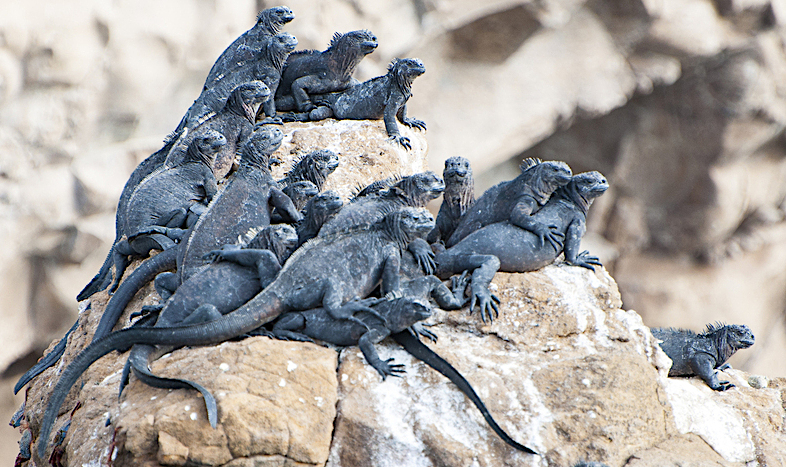
Some communal sunbathing:
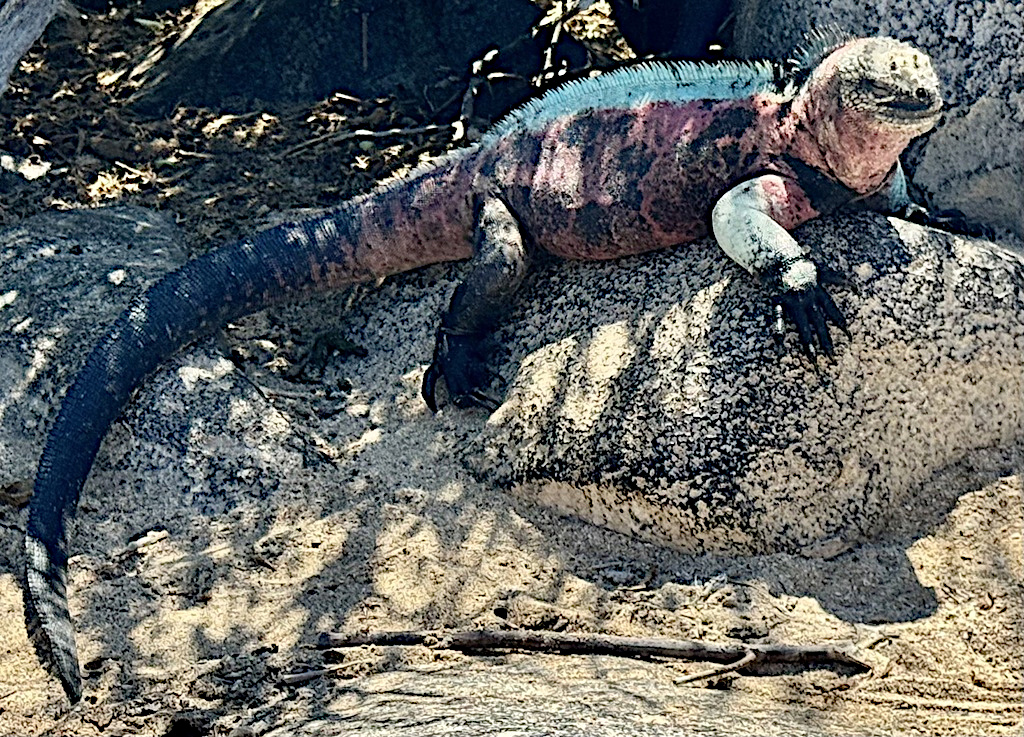
Being very colourful on Española Island:
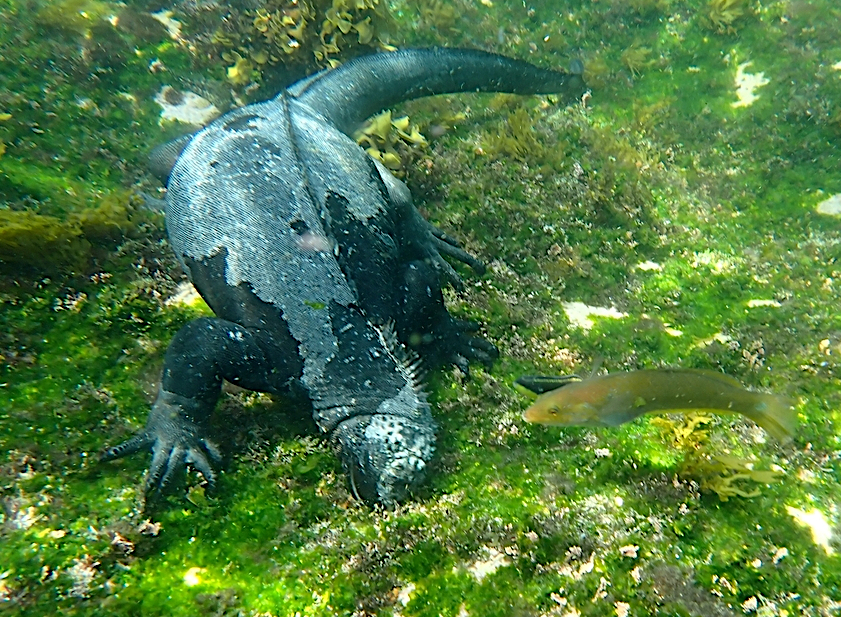
And grazing on green algae underwater:
Some contextual background:
The interesting origin of the phrase ‘Imps of Darkness’ to describe these excellent animals is explianed here (direct link to PDF): Thompson, C, 2015. “Only the Amblyrhynchus“: Maria Graham’s scientific editing of Voyage of HMS Blonde (1826/27)“. Journal of Literature and Science, 8 (1), pp. 48-68.
An introductory explanation of what an El Niño is:
And all (well, some of) the scientific details:
Vitousek, Maren & Rubenstein, Dustin & Wikelski, Martin. (2007). The evolution of foraging behavior in the Galápagos marine iguana: Natural and sexual selection on body size drives ecological, morphological, and behavioral specialization. Publ. in: Lizard Ecology : the Evolutionary Consequences of Foraging Mode / Stephen M. Reilly … (eds.). Cambridge: Cambridge University Press, 2007, pp. 491-507
Wikelski, M. and Trillmich, F. (1997), BODY SIZE AND SEXUAL SIZE DIMORPHISM IN MARINE IGUANAS FLUCTUATE AS A RESULT OF OPPOSING NATURAL AND SEXUAL SELECTION: AN ISLAND COMPARISON. Evolution, 51: 922-936.
Wikelski, M.. (2003). Body Size, Performance and Fitness in Galapagos Marine Iguanas. Integrative and Comparative Biology. 43. 376-386
Shepherd, Scoresby & Hawkes, Michael. (2005). Algal food preferences and seasonal foraging strategy of the marine iguana, Amblyrhynchus cristatus, on Santa Cruz, Galápagos. Bulletin of Marine Science. 77. 51-72.
MacLeod A, Rodríguez A, Vences M, Orozco-terWengel P, García C, Trillmich F, Gentile G, Caccone A, Quezada G, Steinfartz S. Hybridization masks speciation in the evolutionary history of the Galápagos marine iguana. Proc Biol Sci. 2015 Jun 22;282(1809)
Laurie, Andrew. (1990). Effects of the 1982-83 El Niño-Southern Oscillation Event on Marine Iguana (Amblyrhynchus Cristatus Bell, 1825) Populations on Galapagos
(Direct link to PDF) Wikelski, Martin & Thom, Corinna. (2000). Marine Iguanas shrink to survive El Niño. Nature. 403. 37-8. 10.1038/47396.
Shahar Dubiner, Juan Pablo Muñoz-Pérez, Gregory A. Lewbart, Kenneth J. Lohmann, Maximilian Hirschfeld, Daniela Alarcón-Ruales, Thara Carolina Cango Rivadeneira, Andrea Loyola, Shai Meiri, Eran Levin; Marine iguanas have lower metabolic rates during El Niño. J Exp Biol 1 September 2025; 228 (17)
Music
Opening & Closing Themes: Running Waters and Acoustic Meditation by Audionautix (Jason Shaw), from audionautix.com. CC BY 3.0.