
The Colossal Squid (Mesonychoteuthis hamiltoni) is the biggest invertebrate on Earth – a truly enormous mollusc that weighs as much as a bull moose. Yet much about it remains deeply mysterious. It is a hidden wonder of Nature, lurking deep in the Antarctic Ocean …
Subscribe to the Podcast and never miss a Wild Episode! (P.S. Make your friends and family subscribe too!)
And please do E-mail the show if you have any comments, complaints, corrections, suggestions, encouragement or even just want to say hello.
And don’t forget, you can now check out The Wild Episode’s very own Facebook page. And, you can find and follow the show on Twitter!
Show notes, with much more on the Colossal Squid, below …
The best video introduction to the Colossal Squid out there:
And photos … a comparison of Colossal (top) and Giant Squid tentacles … check out the hook vs sucker distinction …

Photo credit: Laika ac from UK, CC BY-SA 2.0, via Wikimedia Commons
… and the fearsome beak of a Colossal Squid:
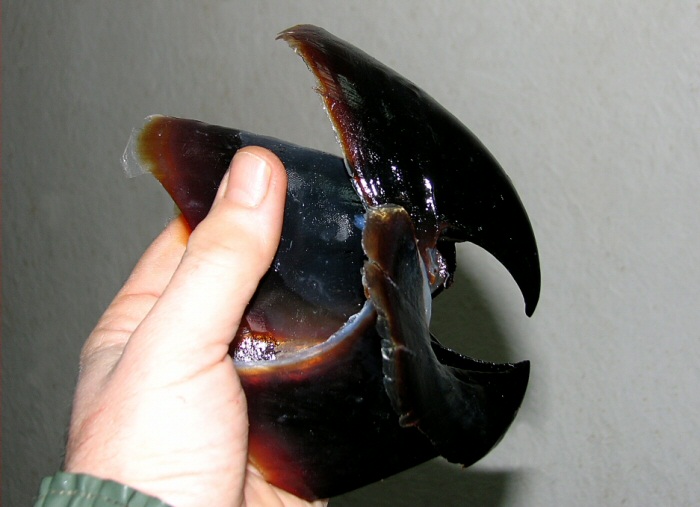
Photo credit: GeSHaFish, CC BY-SA 3.0, via Wikimedia Commons
Here’s a good, not too technical comparison of the Giant and Colossal Squid: Giant Squid and Colossal Squid Fact Sheet
And here’s the first page – only the first page is publicly accessible, as far as I know – of the original 1925 paper reporting the existence of Mesonychoteuthis hamiltoni: On Mesonychoteuthis, a new genus of Œgopsid Cephalopoda
A short New Scientist bit on the Colossal Squid/Toothfish conection: Colossal squid vs huge toothfish – clash of the deep-sea titans
The best overview of current knowledge, as far as I know: Rosa, R. et al. “Biology and ecology of the world’s largest invertebrate, the colossal squid (Mesonychoteuthis hamiltoni): a short review.” Polar Biology 40 (2017): 1871-1883.
More on squid and toothfish fisheries: Alexander, Remeslo & Yakushev, Marat & Laptikhovsky, Vladimir. (2015). Alien vs. Predator: interactions between the colossal squid (Mesonychoteuthis hamiltoni) and the Antarctic toothfish (Dissostichus mawsoni). Journal of Natural History. 49.
Colossal squid as prey:
Cherel Y, Hobson KA. Stable isotopes, beaks and predators: a new tool to study the trophic ecology of cephalopods, including giant and colossal squids. Proc Biol Sci. 2005;272(1572):1601-1607.
Cherel, Yves & Duhamel, Guy. (2004). Antarctic jaws: Cephalopod prey of sharks in Kerguelen waters. Deep Sea Research Part I: Oceanographic Research Papers. 51. 17-31.
And on their remarkable eyes:
Schmitz, Lars & Motani, Ryosuke & Oufiero, Christopher & Martin, Christopher & McGee, Matthew & Gamarra, Ashlee & Lee, Johanna & Wainwright, Peter. (2013). Allometry indicates giant eyes of giant squid are not exceptional. BMC evolutionary biology. 13. 45.
Nilsson, Dan & Warrant, Eric & Johnsen, Sönke & Hanlon, Roger & Shashar, Nadav. (2012). A Unique Advantage for Giant Eyes in Giant Squid. Current biology : CB. 22. 683-8.
A finally, some discussion of bioluminescence in the Colossal Squid: Burton, A. (2013). Radiance of the kraken. Frontiers in Ecology and the Environment, 11(2).
Music
Opening & Closing Themes: Running Waters and Acoustic Meditation by Audionautix (Jason Shaw), from audionautix.com. CC BY 3.0.
Modified versions of:
Spatium by Keys of Moon, CC BY 3.0.
Light Lab, Treated Acoustic Guitar and End of Winter by Rest You Sleeping Giant, CC BY 4.0.