
The Great Slaty Woodpecker (Mulleripicus pulverulentus) is probably the biggest woodpecker in the world. A spectacular inhabitant of Asian forests that’s haunted, perhaps, by the ghosts of two even bigger woodpeckers …
Subscribe to the Podcast and never miss a Wild Episode! (P.S. Make your friends and family subscribe too!)
And please do E-mail the show if you have any comments, complaints, corrections, suggestions, encouragement or even just want to say hello.
And don’t forget, you can now check out The Wild Episode’s very own Facebook page. And, you can find and follow the show on Twitter!
Show notes available below …
The spectacular Great Slaty Woodpecker (photographed in a zoo):
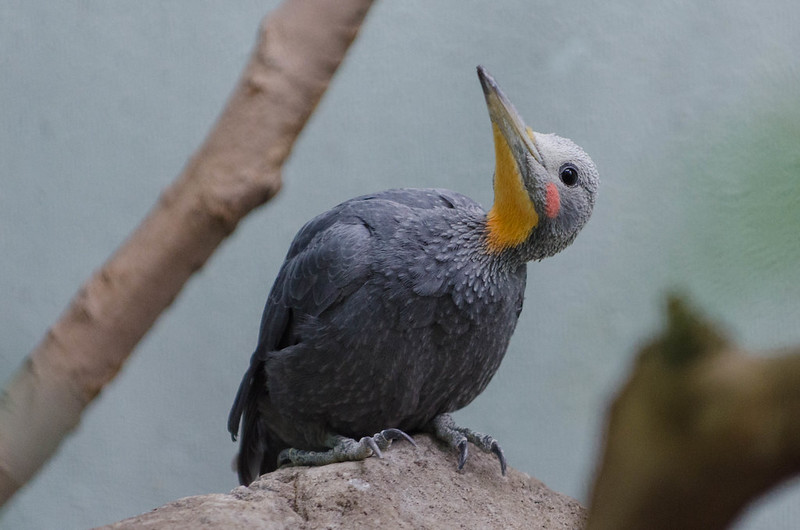
Photo credit: Jason Thompson, via Flickr, CC BY 2.0
And here’s a fantastic photo of them in the wild, demonstrating their sociability:

Photo credit: Md shahanshah bappy – Own work, via wikimedia commons, CC BY-SA 4.0
And a great bit of film of Great Slaty Woodpeckers doing their woodpecker-y things:
And here’s film of the Ivory-billed Woodpecker. A scene very unlikely to ever be recorded again, unfortunately:
And – for reasons I’m not entirely clear on, I find this piece of film even more sad and evocative – here’s a section from what’s pretty much the best footage of the most impressive woodpecker of all – the Imperial Woodpecker – we’re ever likely to see. From 1956:
The full 2021 proposal from the US Fish and Wildlife Service to remove 23 plants and animals (including the Ivory-billed Woodpecker) from the official list of endangered species due to extinction: Endangered and Threatened Wildlife and Plants; Removal of 23 Extinct Species From the Lists of Endangered and Threatened Wildlife and Plants.
A report on that proposal, with a summary of the history of Ivory-billed decline, and the continuing search for it, at phys.org: It may be extinct, but the story of the ivory-billed woodpecker isn’t over yet
The Wikipedia page on the Ivory-bill has a lot of detail (and links to lots more info), on the contested history of sightings, searches and alleged survival of the species.
The Wikipedia page on the Imperial Woodpecker has less info – because less is known – but is still a decent place to start.
One of the best concise but considered reports (in English, freely accessible) on the Imperial Woodpecker and its fate is in: Lammertink et al, 1996, Status and conservation of old-growth forests and endemic birds in the pine-oak zone of the Sierra Madre occidental Mexico, Verslagen en Technische Gegevens, Vol 69, pp 1-89.
But on to (slightly) more cheerful stuff: the really big woodpecker we have left … The Great Slaty!
Raman Kumar, Ghazala Shahabuddin, Ajith Kumar “Foraging Niche Differentiation Among Sympatric Woodpecker Species in Forests of North-Western India,” Acta Ornithologica, 55(1), 88-100, (19 October 2020)
Styring, A., & Hussin, M. (2004). Foraging ecology of woodpeckers in lowland Malaysian rain forests. Journal of Tropical Ecology, 20(5), 487-494.
Lammertink, Martjan. “A Multiple-Site Comparison of Woodpecker Communities in Bornean Lowland and Hill Forests.” Conservation Biology 18 (2004): 746-757.
Martjan Lammertink, Grouping and Cooperative Breeding in the Great Slaty Woodpecker, The Condor, Volume 106, Issue 2, 1 May 2004, Pages 309–319.
Kumar & Shahabuddin, 2012, Assessing the status and distribution of the Great Slaty Woodpecker Mulleripicus pulverulentus (Temminck 1826) in sub-Himalayan Uttarakhand, India, JBNHS, 109, pp 17-22.
Styring, Alison & Zakaria, Mohamed. (2004). Effects of logging on woodpeckers in a Malaysian rain forest: The relationship between resource availability and woodpecker abundance. Journal of Tropical Ecology. 20. 495-504.
Music
Opening & Closing Themes: Running Waters and Acoustic Meditation by Audionautix (Jason Shaw), CC BY 3.0.
Modified versions of:
What Have You Done and Small Steps by Lee Rosevere, CC BY 3.0