
Fenyes’s strepsipteran (Caenocholax fenyesi) is one of the most extraordinary insects in the world. Thanks to a suggestion from listener Athayde, we get to talk about a parasitoid living a deeply strange life – twice over, in fact, since males and females both get up to some remarkable stuff but are wildly different in both form and behaviour …
Subscribe to the Podcast and never miss a Wild Episode! (P.S. Make your friends and family subscribe too!)
And please do E-mail the show if you have any comments, complaints, corrections, suggestions, encouragement or even just want to say hello.
And don’t forget, you can now check out The Wild Episode’s very own Facebook page. And, you can find and follow the show on Twitter!
Show notes available below …
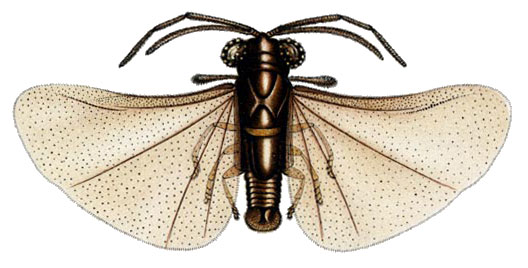
Because they’re tiny and obscure it’s hard to find good images/video of strepsipterans in general, and of Fenyes’s strepsipteran in particular. (Essentially impossible for the latter in fact!). However, here’s a rather nice, detailed, illustration of the male Caenocholax fenyesi:
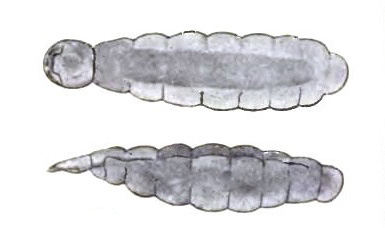
And here’s a sort of basic, general image of a female strepsipteran (NOT C. fenyesi specifically, but to a certain extent, once you’ve seen one female strepsipteran, you get the general idea about all of them. (That’s not true, there is one sub-group of strepsipterans that actually has free-flying females as well as males, but that’s outside the scope of this episode …).
And a little video introduction, which again is not specifically about Caenocholax fenyesi, but does at least give an idea of just how small and strange all strepsipterans are …
A couple of short overviews of the Strepsiptera: one at the website of the Amateur Entomologists’ Society and another at the Royal Entomological Society.
Fortunately, Fenyes’s strepsipteran, Caenocholax fenyesi, is one of the very, very few strepsipterans that actually has a semi-decent amount of info about it on Wikipedia, so it’s worth checking out: Caenocholax fenyesi at Wikipedia.
Unavoidably, though, if you actually want to know more (and there’s a lot more I didn’t have time to cover in the episode) about both the Strepsiptera in general and Fenyes’s example in particular, you need to get into the scientific and semi-scientific literature, starting with a couple of review articles about the big picture:
Kathirithamby, Jeyaraney. (2008). Review of the Order Strepsiptera. Systematic Entomology. 14. 41 – 92
Kathirithamby, Jeyaraney. (2008). Host-Parasitoid Associations in Strepsiptera. Annual review of entomology. 54. 227-49
And then the three main bits of research I specifically talk about in the episode:
Pierce, W. D. 1909. “A monographic revision of the twisted winged insects comprising the order Strepsiptera Kirby.” Bulletin of the United States National Museum. i–xii, 1-232
Kathirithamby J, Johnston JS. The discovery after 94 years of the elusive female of a myrmecolacid (Strepsiptera), and the cryptic species of Caenocholax fenyesi Pierce sensu lato. Proc Biol Sci. 2004;271 Suppl 3(Suppl 3):S5-S8.
Jeyaraney Kathirithamby, J. Spencer Johnston, Stylopization of Solenopsis invicta (Hymenoptera: Formicidae) by Caenocholax fenyesi (Strepsiptera: Myrmecolacidae) in Texas, Annals of the Entomological Society of America, Volume 85, Issue 3, 1 May 1992, Pages 293–297
And some other stuff about Caenocholax fenyesi:
Jerry L. Cook, J. Spencer Johnston, Roger E. Gold, S. Bradleigh Vinson, Distribution of Caenocholax fenyesi (Strepsiptera: Myrmecolacidae) and the Habitats Most Likely To Contain Its Stylopized Host, Solenopsis invicta (Hymenoptera: Formicidae), Environmental Entomology, Volume 26, Issue 6, 1 December 1997, Pages 1258–1262
Hayward, Alexander & Mcmahon, Dino & Kathirithamby, Jeyaraney. (2011). Cryptic diversity and female host specificity in a parasitoid where the sexes utilize hosts from separate orders. Molecular ecology. 20. 1508-28.
Jeyaraney Kathirithamby, David P Hughes, Caenocholax fenyesi (Strepsiptera: Myrmecolacidae) Parasitic in Camponotus planatus (Hymenoptera: Formicidae) in Mexico: Is This the Original Host?, Annals of the Entomological Society of America, Volume 95, Issue 5, 1 September 2002, Pages 558–563
Music
Opening & Closing Themes: Running Waters and Acoustic Meditation by Audionautix (Jason Shaw), from audionautix.com. CC BY 3.0.