
The Sumatran Rhino (Dicerorhinus sumatrensis), the closest living relative of the extinct Woolly Rhinoceros, is the most vocal of all rhinos. And its extraordinary voice is on the very brink of disappearing from the world forever …
Subscribe to the Podcast and never miss a Wild Episode! (P.S. Make your friends and family subscribe too!)
If you want to support the podcast, and help keep it going, please share it on social media, and rate and review it (positively of course!) on your podcast app.
And please do E-mail the show if you have any comments, complaints, corrections, suggestions, encouragement or even just want to say hello.
And don’t forget, you can now check out The Wild Episode’s very own Facebook page. And, you can find and follow the show on Twitter!
Show notes below …
The Sumatran Rhino (charisma overload!):
Two Sumatran Rhinos in Cincinnati Zoo (where the vocalizations in the episode were recorded!), nicely showing off their hairiness:
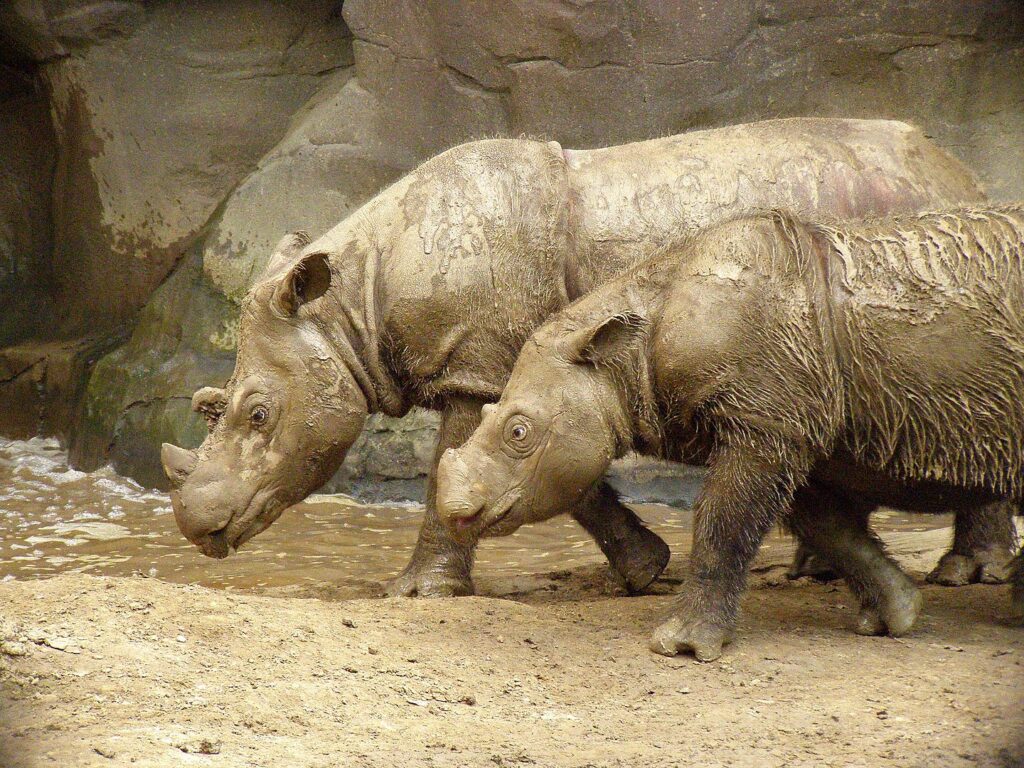
By Charles W. Hardin – Photo Sumatran Rhinos: “Emi” and 14 month old son “Harapan” from Flickr, CC BY 2.0.
The BBC survey that reported Scotland’s Top Ten Favourite Books.
Wikipedia pages for Sunset Song and its author Lewis Grassic Gibbon.
Three Main Documents for this episode:
The original description of the Sumatran Rhino, submitted to the Royal Society of London by William Bell, and read there in 1793, is here: Bell, William, and Joseph Banks. “Description of the Double Horned Rhinoceros of Sumatra. By Mr. William Bell, Surgeon in the Service of the East India Company, at Bencoolen. Communicated by Sir Joseph Banks, Bart. P. R. S.” Philosophical Transactions of the Royal Society of London, vol. 83, 1793, pp. 3–6.
The 1939 paper that talks at length about the Sumatran rhino’s distinctive vocalizations (and much else): Hubback, 1939, The two-horned Asiatic rhinoceros (Dicerorhinus sumatrensis), Journal of the Bombay Natural History Society, 40 (4), 594-617.
The recording of Sumatran rhinos at Cincinatti Zoo: Elizabeth von MuggenthalerPaul ReinhartBrad LympanyR. Barton Craft; Songlike vocalizations from the Sumatran Rhinoceros (Dicerorhinus sumatrensis). ARLO 1 July 2003; 4 (3): 83–88.
And some more:
Borner, 1979, A field study of the Sumatran rhinoceros Dicerorhinus sumatrensis Fischer, 1814: Ecology and behaviour conservation situation in Sumatra, Basel University, Inaugural Dissertation, pp. 1-169.
Strien, N.J. van, 1986, The Sumatran rhinoceros, Dicerorhinus sumatrensis, in the Gunung Leuser National Park, Sumatra, Indonesia: its distribution, ecology and conservation, Mammalia Depicta, No. 12, pp. i-vii, 1-200.
Kretzschmar, Petra & Kramer-Schadt, Stephanie & L, Ambu & Bender, Johannes & Bohm, Torsten & M, Ernsing & Göritz, Frank & Hermes, Robert & Payne, John & Schaffer, Nan & Thayaparan, S.T. & ZZ, Zainal & TB, Hildebrandt & Hofer, Heribert. (2016). The catastrophic decline of the Sumatran rhino (Dicerorhinus sumatrensis harrissoni) in Sabah: Historic exploitation, reduced female reproductive performance and population viability. Global Ecology and Conservation. 6. 257-275.
Schaffer, Nan & Agil, Muhammad & Zainuddin, Zainal. (2020). Ramifications of reproductive diseases on the recovery of the Sumatran Rhinoceros Dicerorhinus sumatrensis (Mammalia: Perissodactyla: Rhinocerotidae). Journal of Threatened Taxa. 12. 15279-15288.
William Z. Lidicker, Jr., The Allee Effect: Its History and Future Importance, The Open Ecology Journal, 2010, 3: 71-82
Music
Opening & Closing Themes: Running Waters and Acoustic Meditation by Audionautix (Jason Shaw), from audionautix.com. CC BY 3.0.
Modified versions of: Pilgrimage – Contemplation and Pilgrimage – Inspiration by Wayne Kinos, CC BY 4.0; Mourn by Mark Wilson X, CC BY 4.0 and Ancient Rite by Kevin MacLeod, CC BY 4.0.
Sumatran Rhino and Humpback Whale vocalizations are from the paper:
Elizabeth von MuggenthalerPaul ReinhartBrad LympanyR. Barton Craft; Songlike vocalizations from the Sumatran Rhinoceros (Dicerorhinus sumatrensis). ARLO 1 July 2003; 4 (3): 83–88 CC BY 4.0