Tarantula Hawk wasps have excruciatingly painful stings, from the human point of view. They also have extraordinarily ambitious hunting behaviour, and a whole constellation of other insects surrounding them and trying very hard to look just like them …
You can support the show – keep it going, keep it growing – at The Wild Episode Substack. Become a paid subscriber to (if there’s enough interest/support!) get access to occasional bonus episodes.
Please do E-mail the show if you have any comments, complaints, corrections, suggestions, encouragement or even just want to say hello.
And don’t forget, you can check out The Wild Episode’s very own Facebook page. And, you can find and follow the show on Twitter!
Please do share the show on social media, and rate and review it (positively of course!) on your podcast app. That helps a lot. But best of all, of course, become a paid subscriber at The Wild Episode Substack. Thank you!
Show notes below …
Just to say, for more general info on The Schmidt Pain Index, and on the whole relationship between venom and pain, you can see the show notes for the previous episode, and listen to the episode itself if you like, here: The Pain Index I – Bullet Ant.
The London Natural History Museum has a nice introductory page Tarantula hawks: The most painful wasp sting in the world explained.
The man himself, however – Justin O. Schmidt – wrote a great piece on tarantula hawks at Undark online magazine: Instantaneous, Electrifying, Excruciating Pain. Much good info, and firsthand experience, there.
Some Tarantula Hawk Wasps of the genus Pepsis:
Pepsis grossa (other colour morphs are available):

Pepsis thisbe

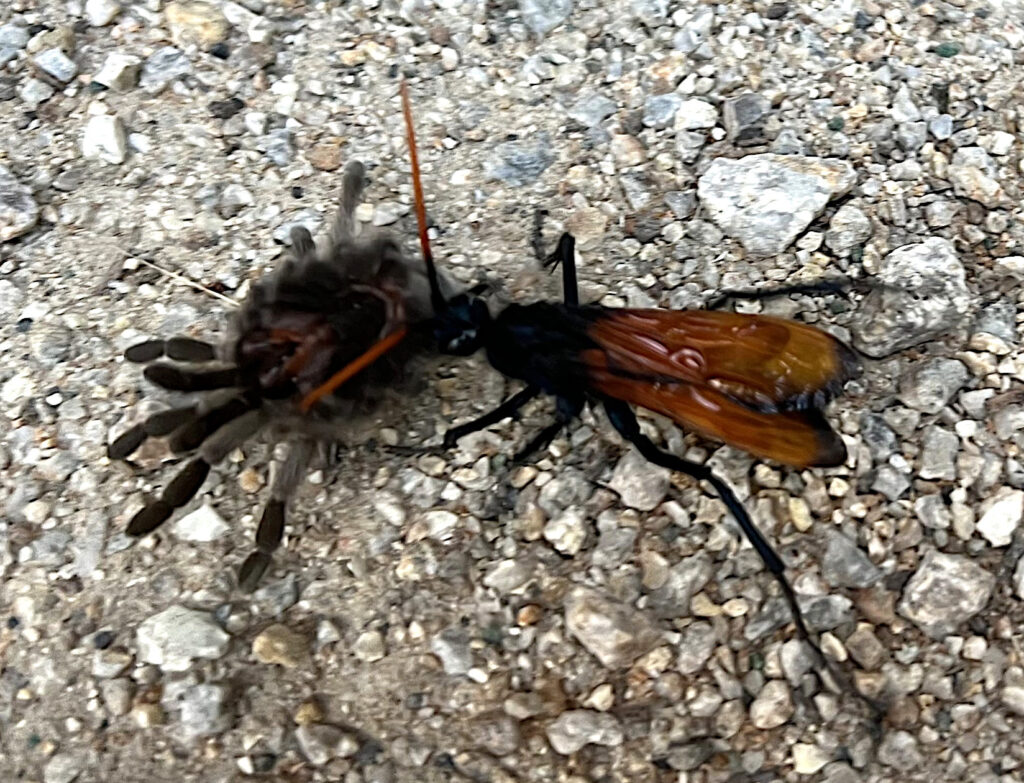
and a third very similar species, Pepsis mildei, dealing with a spider:
And so on to a FESTIVAL OF MIMICRY:
Sphex tepanecus, a completely different sort of wasp (a digger wasp, in fact), looks a whole lot like a tarantula hawk. Coincidence? I mean … probably not, right?:
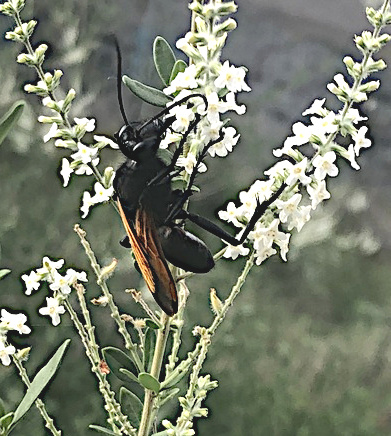
Photo: © cornsnek, via iNaturalist, CC BY 4.0
The Mydas bronzewing, a robber fly:

Photo: © Laura Gaudette, via iNaturalist, CC BY 4.0
An assassin bug, Zelurus spinidorsis:

Photo: © Kai Squires, via iNaturalist, CC BY 4.0
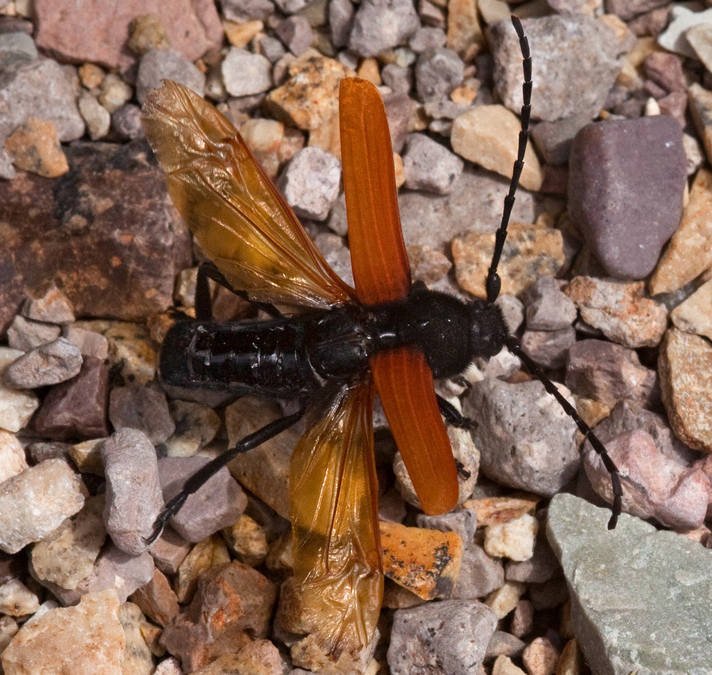
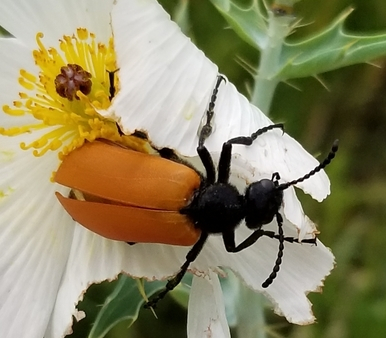
A longhorn beetle in the genus Tragidion (orange wings, but even when it’s wing cases are closed, they’re even more orange, as is nicely shown here):
A blister beetle, Lytta fulvipennis:
A moth (!), Alcathoe pepsioides:

Photo: © Wendy McCrady, via iNaturalist, CC BY 4.0
I could go on, but you get the pretty conclusive idea, I’m sure. One of the most extraordinary and extensive mimicry complexes in Nature, all driven by the pain-inducing capabilities of the Tarantula hawk’s venom.
Schmidt JO. Pain and Lethality Induced by Insect Stings: An Exploratory and Correlational Study. Toxins (Basel). 2019 Jul 21;11(7):427.
Requires a free JSTOR account: Schmidt, Justin O. “Venom and the Good Life in Tarantula Hawks (Hymenoptera: Pompilidae): How to Eat, Not Be Eaten, and Live Long.” Journal of the Kansas Entomological Society, vol. 77, no. 4, 2004, pp. 402–13.
Punzo, Fred, The Biology of the Spider Wasp Pepsis Thisbe (Hymenoptera: Pompilidae) From Trans Pecos, Texas. I. Adult Morphometrics, Larval Development and the Ontogeny of Larval Feeding Patterns, Psyche: A Journal of Entomology, 101, 070378, 13 pages, 1994.
Punzo, Fred, The Biology of the Spider Wasp, Pepsis Thisbe (Hymenoptera: Pompilidae) From Trans Pecos, Texas. II. Temporal Patterns of Activity and Hunting Behavior With Special Reference to the Effects of Experience, Psyche: A Journal of Entomology, 101, 027564, 14 pages, 1994.
Punzo, Fred. “Interspecific variation in hunting behavior of Pepsis grossa Fabricius and Pepsis thisbe Lucas Hymenoptera Pompilidae a field study.” Journal of Hymenoptera Research 16 (2007): 297-310.
Music
Opening & Closing Themes: Running Waters and Acoustic Meditation by Audionautix (Jason Shaw), from audionautix.com. CC BY 3.0.
Modified versions of: Doppler Piano by Mark Wilson X, CC BY 4.0; The Desert Archer by Pipe Choir III, CC BY 4.0; Lucid Coma by Kevin Hartnell, CC BY 4.0.