
The Ochre Sea Star. A remarkable predator that can turn its stomach inside out through its mouth. And is also central to the story of a highly influential concept in ecology: it is the original Keystone Species …
You can support the show – keep it going, keep it growing – at The Wild Episode Substack. Become a paid subscriber there to get access to occasional bonus episodes in future.
Feel free to E-mail the show if you have any comments, complaints, corrections, suggestions, encouragement or even just want to say hello.
Please do share the show on social media, and rate and review it (positively of course!) on your podcast app. That helps a lot. But best of all, of course, become a paid subscriber at The Wild Episode Substack.
And don’t forget, you can check out The Wild Episode’s very own Facebook page. And, you can check out Twitter and BlueSky.
Thank you!
Show notes below …
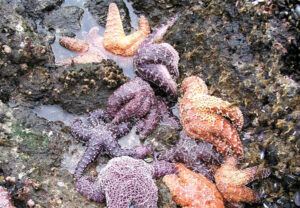
A selection of Ochre Sea Stars (Pisaster ochraceus), illustrating just how very not-ochre they can be:
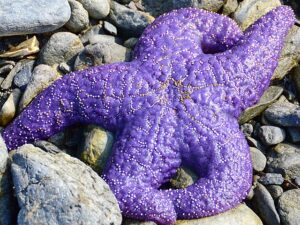
And just one to illustrate how very, very purple an ochre sea star sometimes is:
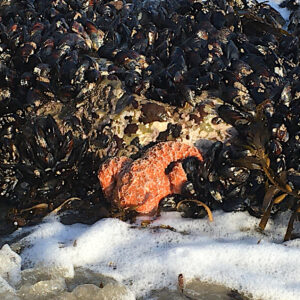
And here, conveniently, is the entire episode illustrated in a single photo: an ochre sea star, sharing a rock in the wave-washed intertidal zone with a load of its favourite food – California mussels.
And here’s a closer look at how the ochre sea star eats a mussel:
Wikipedia on the Ochre Sea Star, on the Keystone Species concept and on Robert Paine.
There’s a good retrospective on Robert Paine’s life and career, which makes a case for him being amongst the most important ecologists, here:
Estes, J.A., Dayton, P.K., Kareiva, P., Levin, S.A., Lubchenco, J., Menge, B.A., Palumbi, S.R., Power, M.E. and Terborgh, J. (2016), A keystone ecologist: Robert Treat Paine, 1933–2016. Ecology, 97: 2905-2909.
Robert Paine’s two ‘key’ papers, the first describing the Makah Bay experiment and the second introducing the keystone species concept (both require a free account at JSTOR to read in full, I think):
Paine, Robert T. “Food Web Complexity and Species Diversity.” The American Naturalist 100, no. 910 (1966): 65–75.
Paine, R. T. “A Note on Trophic Complexity and Community Stability.” The American Naturalist 103, no. 929 (1969): 91–93.
And here’s a good summary of the significance, consequences and afterlife of that work:
Lafferty, Kevin & Suchanek, Tom. (2016). Revisiting Paine’s 1966 Sea Star Removal Experiment, the Most-Cited Empirical Article in the American Naturalist. The American Naturalist. 188
Colour Polymorphism in the Ochre Sea Star : Color Polymorphism and Genetic Structure in the Sea Star Pisaster ochraceus, C. D. G. Harley, M. S. Pankey, J. P. Wares, R. K. Grosberg, and M. J. Wonham, The Biological Bulletin 2006 211:3, 248-262
The Keystone Species concept and its History:
Menge, Bruce & Berlow, Eric & Blanchette, Carol & Navarrete, Sergio & Yamada, Sylvia. (1994). The Keystone Species Concept: Variation in Interaction Strength in a Rocky Intertidal Habitat. Ecological Monographs. 64. 249-286
Mills, L. & Soulé, Michael & Doak, Daniel. (1993). The Keystone-Species Concept in Ecology and Conservation. BioScience. 43. 219-224
Shukla, I., Gaynor, K. M., Worm, B., & Darimont, C. T. (2023). The diversity of animals identified as keystone species. Ecology and Evolution, 13, e10561
L.E. Ogden, Ecologists Struggle to Get a Grip on ‘Keystone Species’, Quanta Magazine 2024.
Sea Star Wasting Disease and its Consequences:
Catherine A Pfister, Robert T Paine, J Timothy Wootton, The iconic keystone predator has a pathogen, Front Ecol Environ 2016; 14(5): 285–286
Miner CM, Burnaford JL, Ambrose RF, Antrim L, Bohlmann H, Blanchette CA, et al. (2018) Large-scale impacts of sea star wasting disease (SSWD) on intertidal sea stars and implications for recovery. PLoS ONE 13(3): e0192870.
Moritsch MM, Raimondi PT. Reduction and recovery of keystone predation pressure after disease-related mass mortality. Ecol Evol. 2018; 8: 3952–3964
Summary of the recent report that shoreline ecosystems have changed and don’t seem to be changing back:
Rocky shores of Pacific Northwest show low resilience to changes in climate.
Music
Opening & Closing Themes: Running Waters and Acoustic Meditation by Audionautix (Jason Shaw), from audionautix.com. CC BY 3.0.
Modified versions of: Clothe the Fields With Plenty by Axletree, CC BY 4.0; Prelude No. 21, Prelude No. 18, Prelude No. 20 and Prelude No. 13 by Chris Zabriskie, CC BY 3.0