Colugos (often called, entirely inaccurately, flying lemurs) – there are two officially recognised species at the moment, the only members of the order Dermoptera – are more dramatically and completely adapted to gliding than any other mammal. They’ve essentially turned their entire bodies into one big gliding surface. Extraordinary animals which also, as it happens, have extraordinary teeth …
Subscribe to the Podcast and never miss a Wild Episode! (P.S. Make your friends and family subscribe too!)
And please do E-mail the show if you have any comments, complaints, corrections, suggestions, encouragement or even just want to say hello.
And don’t forget, you can now check out The Wild Episode’s very own Facebook page. And, you can find and follow the show on Twitter!
Show notes available below …
A Sunda colugo (Galeopterus variegatus), with a baby poking its head out from under the patagium:

Photo: by Wich’yanan L, via iNaturalist, CC BY 4.0
As I mention in the episode, there’s some variation in colouration, so here’s a (pretty gorgeous) ‘red morph’:

Photo: By Bernard DUPONT from FRANCE – Colugo (Cynocephalus variegatus), CC BY-SA 2.0
And here’s a colugo (I refuse to call them flying lemurs) doing the thing for which it is deservedly most famous:
Handy little intro to these amazing animals – especially handy because its got an annotated illustration of their anatomy – is at the WWF website: Flying lemurs—or colugos—can’t technically fly and aren’t technically lemurs.
Before we get into the science, a quick look at the wonderful world of toothcombs. Here’s the toothcomb of the ring-tailed lemur, that I talk about in the episode:

Photo: By Alex Dunkel (Maky) – Own work, via Wikimedia Commons, CC BY 3.0
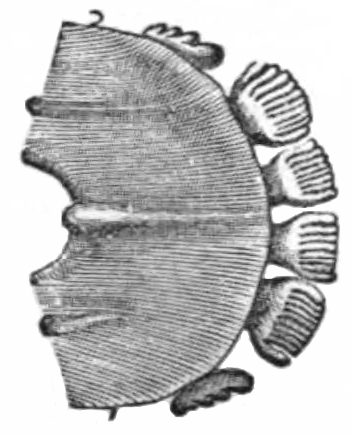
And here, for comparison, is the (I think) way, way more impressive toothcomb of a colugo:
One recently discovered, and very intriguing, characteristic of colugos, which I didn’t even get into in the episode, is that they use … ultrasound! As reported at Mongabay: First record of ultrasound communication in the mysterious Sunda colugo.
On to the science, starting with some papers that draw on that amazing research with data-loggers in Singapore (you can tell it’s interesting/innovative research when it generates multiple papers on significant topics!):
Greg Byrnes, Thomas Libby, Norman T.-L. Lim, Andrew J. Spence; Gliding saves time but not energy in Malayan colugos. J Exp Biol 15 August 2011; 214 (16): 2690–2696.
Byrnes Greg, Lim Norman T.-L and Spence Andrew J, 2008, Take-off and landing kinetics of a free-ranging gliding mammal, the Malayan colugo (Galeopterus variegatus) Proc. R. Soc. B. 275 1007–1013
Greg Byrnes, Norman T.-L. Lim, Charlene Yeong, Andrew J. Spence, Sex differences in the locomotor ecology of a gliding mammal, the Malayan colugo (Galeopterus variegatus), Journal of Mammalogy, Volume 92, Issue 2, 15 April 2011, Pages 444–451
Other stuff:
Jan E. Janečka, Kristofer M. Helgen, Norman T.-L. Lim, Minoru Baba, Masako Izawa, Boeadi, William J. Murphy, Evidence for multiple species of Sunda colugo, Current Biology, Volume 18, Issue 21, 2008, Pages R1001-R1002.
I think I underplayed how confident we can be that there are more than just two species of colugo. See, for example: Schmitz, Jürgen. (2016). Genomic analysis reveals hidden biodiversity within colugos, the sister group to primates. Science Advances. 2. 1-15.
Greg Byrnes, Andrew J. Spence, Ecological and Biomechanical Insights into the Evolution of Gliding in Mammals, Integrative and Comparative Biology, Volume 51, Issue 6, December 2011, Pages 991–1001
Dzulhelmi, Muhammad Nasir and Mohd Tajuddin Abdullah. “Foraging Ecology of the Sunda Colugo (Galeopterus variegatus) in Bako National Park, Sarawak, Malaysia.” Malayan Nature Journal 61 (2009): 285-294.
Zhang ML, Li ML, Ayoola AO, Murphy RW, Wu DD, Shao Y. Conserved sequences identify the closest living relatives of primates. Zool Res. 2019;40(6):532-540.
Music
Opening & Closing Themes: Running Waters and Acoustic Meditation by Audionautix (Jason Shaw), CC BY 3.0.
Modified versions of: Another Brilliant Age and The Last Whale by Jelsonic. CC BY 4.0.