
There are several types of Supergiant Isopod in the deep sea. The first to be discovered, and maybe still the biggest known is Bathynomus giganteus – amongst the most successful and effective scavengers on the planet. But why are they so very big?
You can support the show – keep it going, keep it growing – at The Wild Episode Substack. Become a paid subscriber there to get access to occasional bonus episodes. If you’d rather just stick with a free sign-up there, that’s fine: you’ll still get regular posts/e-mails celebrating the wonders and curiosities of the Animal Kingdom.
Feel free to E-mail the show if you have any comments, complaints, corrections, suggestions, encouragement or even just want to say hello.
Please do share the show on social media, and rate and review it (positively of course!) on your podcast app. That helps a lot. But best of all, of course, become a paid subscriber at The Wild Episode Substack.
And don’t forget, you can check out The Wild Episode’s very own Facebook page. And, you can check out Twitter and BlueSky.
Thank you!
Show notes below …
Bathynomus giganteus, the original Supergiant Isopod, out in the wild:

And the underside, where you can see the fourteen walking legs to the left and the gills/swimming appendages on the right, folded flat like overlaid plates on the underside of the abdomen:
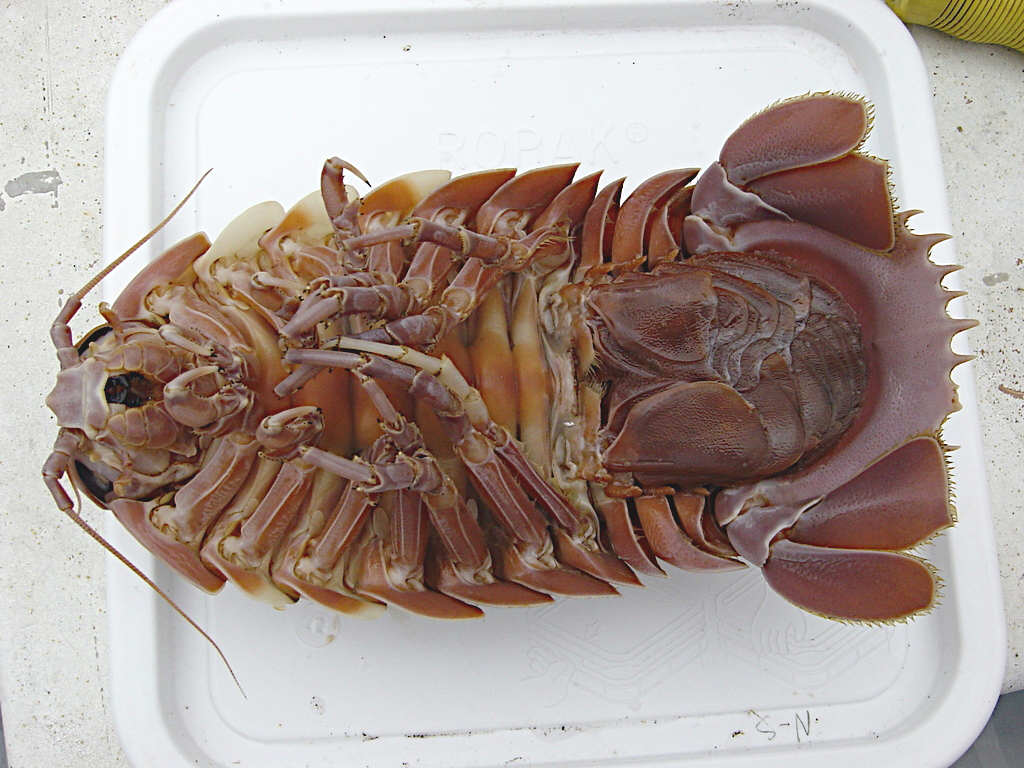 Photo: Tom Kennedy via iNaturalist, CC BY 4.0
And here’s the (I think) impressively effective and graceful swimming happening:
And here’s a close-up, just because I think these guys have an underappreciated adorableness about them when you really look:
There’s nice, very concise introduction to giant isopods at the Natural History Museum page.
The isopod in a Japanese aquarium who lived for five years without food is discussed here at NPR.
Alexander Agassiz, who basically collected the first specimens, and Alphonse Milne-Edwards, who described and named the species, are both pretty interesting guys, with fascinating lives and interests.
I’m just going to link to a few Wikipedia pages for some of the concepts/’rules’ mentioned in this episode, as starting points should you want to follow any of them up:
Polar gigantism doesn’t seem to have it’s own Wikipedia page, as far as I can tell, so: Ask a Marine Biologist: Why Are Polar Ocean Animals Giant? (That link covers something I cut from the episode for reasons of time and simplicity: the suggestion that oxygen is significant in determining animal size in cold water. Like everything else, remains unclear whether it’s actually a – or the – key factor).
Science:
The original description of the species (I like it because it’s got words like ‘extraordinary’ and ‘remarkable’ in it): Milne-Edwards, A. 1879. On a gigantic isopod from the great depths of the sea. Annals and Magazine of Natural History 5:241-243
The single paper I’ve linked to in more show notes than any other at this point, I think: McClain CR, Balk MA, Benfield MC, Branch TA, Chen C, Cosgrove J, Dove AD, Gaskins L, Helm RR, Hochberg FG, Lee FB, Marshall A, McMurray SE, Schanche C, Stone SN, Thaler AD. Sizing ocean giants: patterns of intraspecific size variation in marine megafauna. PeerJ. 2015 Jan 13;3:e715.
Soto, Jules & Mincarone, Michael. (2001). Distribution and morphology of the giant isopods Bathynomus giganteus and Bathynomus miyarei (Flabellifera, Cirolanidae) off southern Brazil. 1. 141-145.
Briones-Fourzan, Patricia & Lozano-Álvarez, Enrique. (1991). Aspects of the Biology of the Giant Isopod Bathynomus Giganteus a. Milne Edwards, 1879 (Flabellifera: Cirolanidae), Off the Yucatan Peninsula. Journal of Crustacean Biology. 11. 375
Barradas-Ortiz, Cecilia & Briones-Fourzan, Patricia & Lozano-Álvarez, Enrique. (2003). Seasonal reproduction and feeding ecology of giant isopods Bathynomus giganteus from the continental slope of the Yucatán peninsula. Deep-sea Research Part I-oceanographic Research Papers – DEEP-SEA RES PT I-OCEANOG RES. 50. 495-513.
Boos, Harry & Scalco, Allan & Araujo, Paula. (2021). Biological and ecological traits of Bathynomus giganteus and Bathynomus miyarei (Crustacea: Isopoda): Contribution to the conservation of deep‐sea in southern Brazil. Aquatic Conservation: Marine and Freshwater Ecosystems. 31
Music
Opening & Closing Themes: Running Waters and Acoustic Meditation by Audionautix (Jason Shaw), from audionautix.com. CC BY 3.0.
Modified versions of: The Unfathomable Deep by Aldous Ichnite, CC BY 4.0; Dawn, Worship the Sun and Faith by Mark Wilson X, CC BY 3.0