
Lumholtz’s Tree Kangaroo (Dendrolagus lumholtzi) is one of only two species of tree kangaroo in Australia. Animals change, the world changes, the natural world is – almost – never standing still.
You can support the show – keep it going, keep it growing – at The Wild Episode Substack. Become a paid subscriber there to get access to occasional bonus episodes and to keep the show on the road. Even as a free subscriber, you’ll still get regular posts/e-mails celebrating the wonders and curiosities of the Animal Kingdom.
Feel free to E-mail the show if you have any comments, complaints, corrections, suggestions, encouragement or even just want to say hello.
Please do share the show on social media, and rate and review it on your podcast app. That helps a lot. But best of all, of course, become a paid subscriber at The Wild Episode Substack.
Neither me nor the show is terribly active on social media, but you can check out The Wild Episode’s very own Facebook page. And, I’m on BlueSky.
Thank you!
Show notes below …
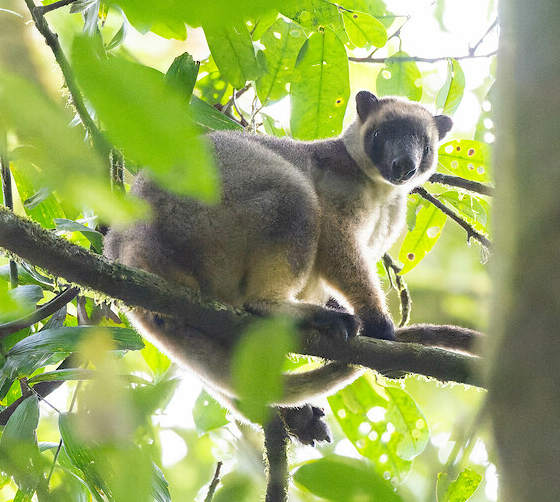
Lumholtz’s Tree Kangaroo (Dendrolagus lumholtzi):
And here’s an adorable mother and child, nicely showing off climbing ability and the much more developed forelimbs (compared to most of their macropod relatives) that help them in that:
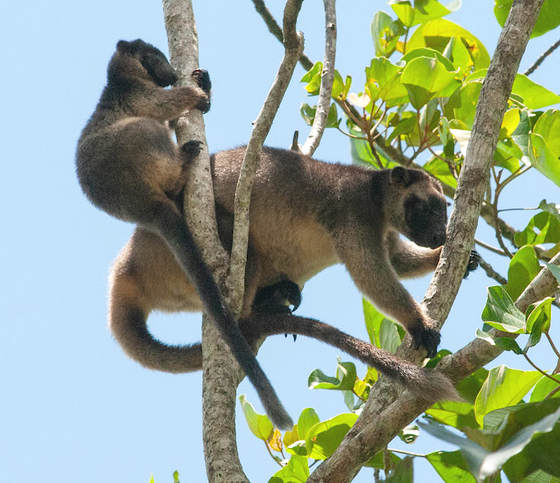
Photo credit: Rolf Lawrenz via iNaturalist, CC BY 4.0
A photo portrait of Carl Lumholtz – and a more ‘of its time’ image it’s hard to imagine:

You can read the entire book he wrote about his travels in Australia – which includes lots of stuff about his quest for a tree kangaroo – free online via Project Gutenberg. Simultaneously kind of fascinating and distinctly racist (which sounds a bit like a description of the 19th century in general, now I think of it). A strong clue about what to expect is in the title: Among Cannibals by Carl Lumholtz.
A couple of good sources for general information about what we know about the species:
Lumholtz’s tree kangaroo on the IUCN Red List (it’s classified as Near Threatened).
Lumholtz’s tree kangaroo on the Animal Diversity Web.
A recent-ish overview of conservation issues and priorities for tree kangaroos in Australia: Kanowski, John. (2021). Conservation of Australian Tree Kangaroos: Current Issues and Future Prospects.
Science:
Warburton, N.M., Harvey, K.J., Prideaux, G.J. and O’Shea, J.E. (2011), Functional morphology of the forelimb of living and extinct tree-kangaroos (Marsupialia: Macropodidae). J. Morphol., 272: 1230-1244.
Warburton, Natalie & Yakovleff, Maud & Malric, Auréline. (2012). Anatomical adaptations of the hind limb musculature of tree-kangaroos for arboreal locomotion (Marsupialia : Macropodinae). Australian Journal of Zoology. 60. 246-258.
Iwaniuk, Andrew & Nelson, John & Ivanco, T & Pellis, S & Whishaw, Ian. (1998). Reaching, grasping and manipulation of food objects by two tree kangaroo species, Dendrolagus lumholtzi and Dendrolagus matschiei. Australian Journal of Zoology. 46. 235-248.
Requires free account on JSTOR: Procter-Gray, Elizabeth, and Udo Ganslosser. “The Individual Behaviors of Lumholtz’s Tree-Kangaroo: Repertoire and Taxonomic Implications.” Journal of Mammalogy, vol. 67, no. 2, 1986, pp. 343–52.
Direct Link to PDF: Heise-Pavlov, Sigrid & Jackrel, Sara & Meeks, Spenser. (2011). Conservation of a rare arboreal mammal: Habitat preferences of the Lumholtz’s tree-kangaroo, Dendrolagus lumholtzi. Australian Mammalogy. 33. 5-12
Bowyer, Jocelyn & Newell, Graeme & Eldridge, Mark. (2002). Genetic effects of habitat contraction on Lumholtz’s tree-kangaroo (Dendrolagus lumholtzi) in the Australian Wet Tropics. Conservation Genetics. 3
Graeme R Newell, Responses of Lumholtz’s tree-kangaroo (Dendrolagus lumholtzi) to loss of habitat within a tropical rainforest fragment, Biological Conservation, Volume 91, Issues 2–3, 1999, Pages 181-189
Matthew R. McCurry et al., A Lagerstätte from Australia provides insight into the nature of Miocene mesic ecosystems. Sci. Adv.8, eabm1406(2022).
Williams, Stephen & Bolitho, Elizabeth & Fox, Samantha. (2003). Climate change in Australian tropical rainforests: An impending environmental catastrophe. Proceedings. Biological sciences / The Royal Society. 270. 1887-92.
Music
Opening & Closing Themes: Running Waters and Acoustic Meditation by Audionautix (Jason Shaw), from audionautix.com. CC BY 3.0.
Modified versions of: A Perfect Storm and Paradisomala by Jon Shuemaker, CC BY 4.0; Magic Hour by Three Chain Links, CC BY 4.0; Short Song 030523 by Chris Zabriskie, CC BY 4.0